PDF(2551 KB)

考虑频率-惯量协同约束的沙戈荒地区光热-光伏联合电站智能调度
陈实, 晏红平, 臧天磊, 刘艺洪, 陈江平, 王舒灏, 李华强
电力建设 ›› 2026, Vol. 47 ›› Issue (8) : 101-118.
PDF(2551 KB)
 PDF(2551 KB)
考虑频率-惯量协同约束的沙戈荒地区光热-光伏联合电站智能调度
Optimized Dispatch for CSP-PV Hybrid Plants in Sandy-Gobi-Desert Regions Considering Frequency-Inertia Coordinated Constraints
【目的】针对我国“沙戈荒”大型新能源基地并网面临的高渗透率与低惯量特征,以及传统调度方法主要围绕稳态功率平衡和经济运行,对频率安全隐患关注不足的局限,本文提出一种计及广义惯量与频率变化率硬约束的光热-光伏联合电站优化调度方法。【方法】首先,构建包含光热同步机物理特性的频率安全边界模型,将优化调度建模为马尔可夫决策过程。其次,针对传统双延迟深度确定性策略梯度算法(twin delayed deep deterministic policy gradient, TD3)在长周期储热状态感知及稀疏频率越限样本学习上的不足,提出一种融合长短期记忆网络(long short-term memory, LSTM)与优先经验回放(prioritized experience replay, PER)的改进TD3(LSTM-PER-TD3)算法。【结果】基于改进IEEE-30及IEEE-57节点系统的多场景仿真表明:所提LSTM-PER-TD3算法在完整频率-惯量约束场景下实现了频率越限与备用短缺双零,且总运行成本与混合整数线性规划(mixed integer linear programming, MILP)方法得到的理论最优解仅相差2.94%。【结论】光热电站同时具备储热时移调节能力与同步机组物理惯量支撑双重优势,能够为高比例新能源基地筑牢频率安全保障;所构建的LSTM-PER-TD3优化算法,在兼顾运行安全性与经济性的前提下实现了机组高效调度,可为高比例新能源电力系统并网运行下的主动频率支撑与智能化经济调度提供理论依据与技术支撑。
[Objective] To address the high penetration and low-inertia characteristics arising from the grid integration of large-scale renewable energy bases in “sandy-gobi-desert” regions, as well as the limitations of traditional dispatch methods that primarily focus on steady-state power balance and economic operation with insufficient attention to frequency security risks, this paper proposes an optimal dispatch method for concentrated solar power-photovoltaic hybrid power plants considering generalized inertia and rate of change of frequency hard constraints. [Methods] First, the optimal dispatch of concentrated solar power-photovoltaic hybrid power plants is modeled as a markov decision process. This model incorporates dynamic security constraints, such as the rate of change of frequency and generalized inertia, to achieve strict control over grid frequency security boundaries. Second, to efficiently solve this highly nonlinear scheduling model and overcome the limitations of the conventional twin delayed deep deterministic policy gradient (TD3) algorithm—specifically addressing the low utilization efficiency of historical information and the insufficient learning of critical disturbance samples—an improved TD3 algorithm integrating long short-term memory (LSTM) networks and a prioritized experience replay (PER) mechanism is proposed. [Results] Multi-scenario simulation results based on modified IEEE-30 and IEEE-57 bus systems demonstrate that, under the complete frequency-inertia constrained scenario, the proposed LSTM-PER-TD3 algorithm achieves zero frequency-limit violations and zero reserve shortage, with a total operating cost only 2.94% above the mixed integer linear programming (MILP) theoretical optimum. [Conclusions] Concentrating solar power plants possess dual advantages of thermal energy storage for time-shifting regulation and physical inertia support from synchronous units, which can firmly guarantee frequency security for high-penetration new energy bases. The developed LSTM-PER-TD3 optimization algorithm realizes efficient unit scheduling while balancing operational safety and economy. It provides theoretical foundations and technical support for active frequency support and intelligent economic scheduling of power systems with high-penetration new energy integration.
沙戈荒地区 / 光热-光伏联合电站 / 频率稳定 / 频率-惯量约束 / 深度强化学习
sandy-gobi-desert regions / concentrated solar power-photovoltaic hybrid power plant / frequency stability / frequency-inertia constraints / deep reinforcement learning
1)功率平衡约束。
系统需要保证运行时段都满足负荷需求:
式中:
2)系统机组运行约束:包括出力上下限约束和爬坡约束。
式中:
3)储热模块充放热状态约束。
TES系统是CSP区别于其他可再生能源的关键组成部分:
式中:
式中:
4)系统旋转备用功率约束。
当新能源在峰值负荷向下波动时,光热发电可以利用更多的热能来增加功率,实现提供正旋转储备。当新能源在谷负荷处向上波动时,光热发电通过主动控制降低汽轮机的输出,可用热能储存在TES中,以备后期使用,实现提供负旋转储备。本文考虑CSP和火电机组联合提供旋转储备。
式中:
式中:
式中:
表B1 常规发电机组关键参数Table B1 Parameters of conventional generator units |
| 发电机(位置) | 最小出力/MW | 最大出力/MW | 爬坡限制/(MW·h-1) | 一次调频爬坡率/(MW·s-1) | 等效惯性常数/s | 发电成本/ (元/MWh) |
|---|---|---|---|---|---|---|
| G2(Bus1) | 75 | 120 | 30 | 2.2 | 6 | 144 |
| G5(Bus4) | 50 | 80 | 20 | 1.8 | 4 | 126 |
| G11(Bus10) | 25 | 50 | 15 | 1.2 | 5.1 | 162 |
| G13(Bus12) | 12 | 30 | 10 | 1.2 | 5.5 | 108 |
表B2 新能源联合电站设备参数Table B2 Parameters of hybrid renewable energy power plant equipment |
| 设备类型 | 参数 | 数值 |
|---|---|---|
| 储热系统(TES) | 最大储热容量/MWh | 3500 |
| 最大充热功率/MW | 900 | |
| 最大放热功率/MW | 250 | |
| SOC上限 | 0.95 | |
| SOC下限 | 0.10 | |
| 初始SOC | 0.35 | |
| 自放热损失率 | 0.031 | |
| 光热发电(CSP) | 额定发电功率/MW | 100 |
| 光-热-电转换效率 | 0.38 | |
| 爬坡限制/(MW·h-1) | 80 | |
| 一次调频爬坡率/(MW·s⁻¹) | 5.0 | |
| 运维成本/(元/MWh) | 36 | |
| 等效惯性常数/s | 4.0 | |
| 光伏发电(PV) | 额定装机容量/MW | 200 |
| 运维成本/(元/MWh) | 28.8 | |
| 电加热器(EH) | 额定功率/MW | 120 |
| 电-热转换效率 | 0.95 | |
| 频率安全参数 | 一次调频评估窗口/s | 7.5 |
表B3 LSTM-PER-TD3算法网络结构Table B3 Network structure of the LSTM-PER-TD3 algorithm |
| 网络名称 | 网络结构 | 神经元维度 |
|---|---|---|
| 共享记忆网络 | 输入层 | 15(状态维度) |
| LSTM层+ReLu | 128 | |
| Actor网络 | 全连接层+ReLu | 256 |
| 全连接层+ReLu | 256 | |
| 全连接层+Tanh(输出) | 11(动作维度) | |
| Critic网络 | (记忆网络输出,动作)拼接输入 | 128+11 |
| 全连接层+ReLu | 256 | |
| 全连接层+ReLu | 256 | |
| 全连接层(输出) | 1(Q值) |
表B4 改进TD3算法超参数设置Table B4 Key Hyperparameter settings of improved TD3 algorithm |
| 网络 | 学习率 | 折扣因子 | 软更新率 | 经验回放池容量 | 训练总回合数 |
|---|---|---|---|---|---|
| Actor | 0.000 1 | 0.99 | 0.005 | 300 000 | 1500 |
| Critic | 0.001 0 | 0.99 | 0.005 | 300 000 | 1500 |
1)LSTM输入序列长度选取依据。
选取2 h、4 h、6 h和8 h四种不同序列长度对算法性能进行了对比测试,测试结果如附表C1所示。
表C1 不同LSTM输入序列长度下的算法性能对比Table C1 Algorithm performance comparison under different LSTM input sequence lengths |
| LSTM输入序列长度/h | 收敛所需平均回合数 | 收敛后系统总运行成本/万元 | 单步决策平均耗时/ms |
|---|---|---|---|
| 2 | 1450 | 102.451 | 14.2 |
| 4 | 1120 | 98.033 | 17.8 |
| 6 | 1380 | 99.127 | 25.5 |
| 8 | 1800 | 104.680 | 34.6 |
由表C1可知,当输入序列较短时,智能体难以完整提取储热系统长周期的能量时移特征,决策存在“短视”现象,导致系统运行成本偏高。反之,当输入序列过长时,庞大的状态空间不仅增加了单步计算耗时,其引入的远期冗余噪声更严重干扰了网络梯度的稳定更新,导致收敛回合数剧增甚至陷入次优策略。实验结果表明,选取4 h能够在时序感知完整性与计算效率之间取得最优平衡。
2)优先经验回放关键超参数整定分析。
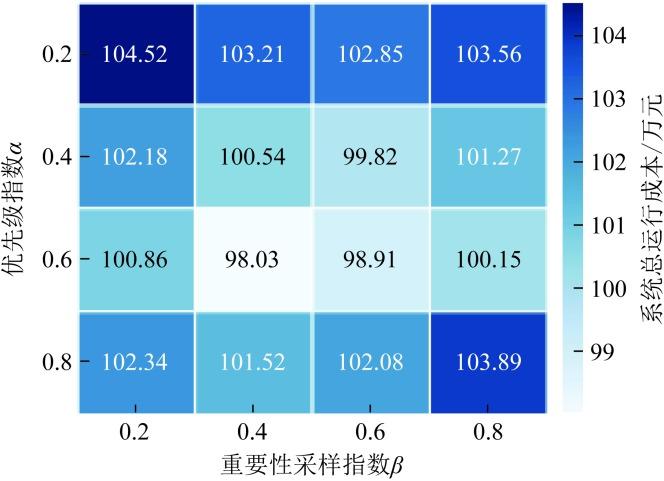
为确定最佳参数组合,本文在保持其他参数不变的条件下,对α与β组成的16组参数网格进行了交叉验证,将各组参数收敛后的系统总运行成本绘制成参数敏感性热力图,如附图C1所示。
图C1 不同α与β组合下的总运行成本参数敏感性热力图Fig. C1 Parameter sensitivity heatmap of total operation cost under different combinations of α and β |
测试结果表明:当α过小,趋近于均匀采样;当α过大,导致过度拟合少数极端样本时,算法均无法获得理想的调度策略;同时,β值需与α良好匹配以消除梯度偏差。实验结果表明,当设定α=0.6,β=0.4时,智能体表现出最优的综合寻优性能。
表D1 常规发电机组关键参数(IEEE-57节点测试系统)Table D1 Parameters of conventional generator units (IEEE 57-bus test system) |
| 发电机编号 | 最小出力/MW | 最大出力/MW | 爬坡限制/ (MW·h⁻¹) | 一次调频爬坡率/(MW·s⁻¹) | 等效惯性常数/s | 发电成本/ (元/MWh) |
|---|---|---|---|---|---|---|
| G0 | 50 | 100 | 25 | 1.2 | 5.0 | 144 |
| G1 | 70 | 140 | 40 | 2.2 | 6.0 | 158 |
| G2 | 50 | 100 | 25 | 1.2 | 5.0 | 144 |
| G3 | 50 | 100 | 30 | 1.8 | 5.5 | 180 |
| G4 | 210 | 410 | 100 | 2.5 | 6.5 | 166 |
表D2 新能源联合电站设备参数(IEEE-57节点测试系统)Table D2 Parameters of hybrid renewable energy power plant equipment (IEEE 57-bus test system) |
| 设备类型 | 参数 | 数值 |
|---|---|---|
| 储热系统(TES) | 最大储热容量/MWh | 7000 |
| 最大充热功率/MW | 1500 | |
| 最大放热功率/MW | 500 | |
| SOC上限 | 0.95 | |
| SOC下限 | 0.10 | |
| 初始SOC | 0.50 | |
| 小时自放热损失率 | 0.031 | |
| 光热发电(CSP) | 额定发电功率/MW | 200 |
| 光-热-电转换效率 | 0.38 | |
| 小时爬坡限制/(MW·h-1) | 80 | |
| 一次调频爬坡率/(MW·s⁻¹) | 5.0 | |
| 运维成本/(元/MWh) | 36 | |
| 等效惯性常数/s | 4.0 | |
| 光伏发电(PV) | 额定装机容量/MW | 400 |
| 运维成本/(元/MWh) | 28.8 | |
| 电加热器(EH) | 额定功率/MW | 250 |
| 电-热转换效率 | 0.95 | |
| 频率安全参数 | 一次调频评估窗口/s | 7.5 |
表D3 LSTM-PER-TD3算法网络结构(IEEE-57节点测试系统)Table D3 Network structure of the LSTM-PER-TD3 algorithm (IEEE 57-bus test system) |
| 网络名称 | 网络结构 | 神经元维度 |
|---|---|---|
| 共享记 忆网络 | 输入层 | 15 |
| LSTM层+ReLu | 256 | |
| Actor网络 | 全连接层+ReLu | 512 |
| 全连接层+ReLu | 512 | |
| 全连接层+Tanh(输出) | 11 | |
| Critic网络 | (记忆网络输出,动作)拼接输入 | 256+11 |
| 全连接层+ReLu | 512 | |
| 全连接层+ReLu | 512 | |
| 全连接层(输出) | 1 |
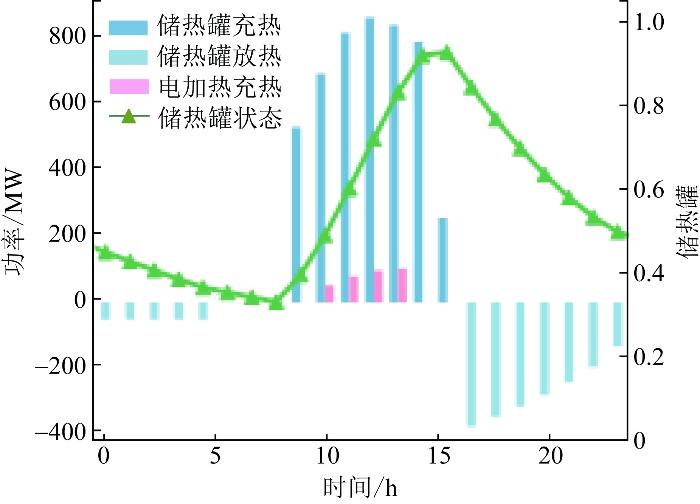
图D2 储热罐充放热功率以及对应的SOC变化曲线Fig. D2 Charging/discharging power and SOC variation curve of thermal storage tank |
| [1] |
张智刚, 康重庆. 碳中和目标下构建新型电力系统的挑战与展望[J]. 中国电机工程学报, 2022, 42(8): 2806-2818.
|
| [2] |
国家能源局. 2025年全国电力工业统计数据简报[EB/OL].(2025-07-31)[2025-10-20]. https://www.nea.gov.cn/20250731/36b5b3b74d344325bb67f38b8e943c18/c.html.
National Energy Administration. Briefing on national power industry statistics in 2025[EB/OL]. (2025-07-31) [2025-10-20]. https://www.nea.gov.cn/20250731/36b5b3b74d344325bb67f38b8e943c18/c.html.
|
| [3] |
王杨, 罗抒予, 姚凌翔, 等. 面向大型新能源基地的太阳能光热发电规划研究综述: 场景、模型与发展方向[J]. 电网技术, 2025, 49(7): 2712-2724.
|
| [4] |
李湃, 王伟胜, 黄越辉, 等. 大规模新能源基地经特高压直流送出系统中长期运行方式优化方法[J]. 电网技术, 2023, 47(1): 31-40.
|
| [5] |
沙韵, 周明, 杨宏基, 等. 考虑光热电站和直流联络线灵活性的高比例新能源互联系统优化运行[J]. 电网技术, 2020, 44(9): 3306-3313.
|
| [6] |
陈实, 郭正伟, 周步祥, 等. 考虑5G基站储能可调度容量的有源配电网协同优化调度方法[J]. 电网技术, 2023, 47(12): 5225-5237.
|
| [7] |
陈实, 唐国登, 刘艺洪, 等. 基于条件风险强化学习的梯级水光蓄联合优化调度[J]. 电力建设, 2025, 46(9): 84-97.
|
| [8] |
孙惠娟, 段伟男, 陈俐, 等. 基于乐观行动-评判深度强化学习的含氢综合能源系统低碳经济调度[J]. 电网技术, 2024, 48(5): 1873-1883.
|
| [9] |
|
| [10] |
|
| [11] |
苏志军, 夏世威, 李庚银, 等. 考虑光热电站接入的电力系统暂态功角稳定性分析[J]. 高压电器, 2025, 61(5): 228-236.
|
| [12] |
周灿, 周育才, 谭艳祥, 等. 基于聚类和RIME-LightGBM的光热电站太阳直接法向辐射预测[J]. 电力科学与技术学报, 2025, 40(6): 241-249.
|
| [13] |
慈俊昌. 熔融盐储热技术在光热发电领域的工程应用进展[J]. 南方能源建设, 2025, 12(5): 85-99.
|
| [14] |
邹博, 任建地, 许道明, 等. 氯化物熔盐储热技术应用于新能源发电的研究进展[J]. 发电技术, 2025, 46(5): 872-884.
目的 “双碳”背景下,熔盐储热技术得到了迅速发展。氯化物熔盐因其良好的储能密度、宽工作温度范围及低成本等优势,被广泛应用于太阳能光热发电与可再生能源调峰等领域,因此综述了氯化物熔盐应用在新能源发电领域的研究进展。 方法 综述了国内外氯化物熔盐材料研究,总结了氯化物熔盐导热系数的强化手段,概述了氯化物熔盐相变行为的测试手段及调节方法,阐述了氯化物熔盐的腐蚀性研究。重点介绍了氯化物熔盐在光热发电、新能源消纳、火电厂改造等领域的应用。其中,光热发电是氯化物熔盐在大规模储能的重要应用,新能源消纳是氯化物熔盐应用的一个新思路。最后,展望了氯化物熔盐储热技术未来发展中需重点思考和解决的问题。 结论 开发能够承受高温和腐蚀环境的合金材料、探索成本效益高的腐蚀控制技术以及协同开发氯化物熔盐净化和缓蚀方法,是实现熔盐储热技术商业化的关键问题。采用熔盐储热技术对传统能源系统进行转型升级,实现能源清洁高效利用是能源领域发展的重要趋势。
Objectives Under the background of “double carbon”, molten salt thermal storage technology has been developed rapidly. Chloride molten salt has been used in solar thermal power generation and renewable energy peaking due to its advantages of good energy storage density, wide operating temperature range and low cost, therefore, the research progress of chloride molten salts in the field of new energy power generation is reviewed. Methods This work reviews domestic and international research on chloride molten salt materials, summarizes the methods to improve the thermal conductivity of chloride molten salts, outlines the measurement and regulation ways for the phase change behavior of chloride molten salts, and describes the corrosion studies on chloride molten salts. The application of chloride molten salt in the fields of photovoltaic power generation, new energy consumption and thermal power plant renovation is highlighted. It is pointed out that photovoltaic power generation is an important application of chloride molten salt in large-scale energy storage, and renewable energy consumption is a new strategy for the application of chloride molten salt. Finally, it outlooks the problems that need to be solved in the future development of chloride molten salt heat storage technology. Conclusions The development of alloy materials capable of withstanding high temperatures and corrosive environments, the exploration of cost-effective corrosion control technologies, and the collaborative development of chloride molten salt purification and corrosion mitigation methods are proposed as key issues for the commercialization of molten salt thermal storage technology. The transformation and upgrading of traditional energy systems by adopting molten salt thermal storage technology to realize clean and efficient energy utilization is an important trend in the future development of the energy field. |
| [15] |
龙潇, 张晋宾, 陈令特. 未来能源技术展望[J]. 发电技术, 2025, 46(4): 651-693.
目的 发展未来能源不仅是当前国际竞争的焦点,也是我国构建新型能源体系、高质量推进中国式现代化建设的必由之路。基于此,探讨了未来能源技术类别、研究现状以及未来发展趋势,旨在为相关领域的研究和政策制定提供参考。 方法 基于国际权威机构报告及全球典型项目数据,采用多维度分析方法,系统介绍了绿色低碳电源、生物能、合成烃燃料及氢能的全球研发现状。通过技术成熟度分级框架,结合经济性指标、政策支持力度及商业化案例,重点解析了各技术路线的关键突破、应用瓶颈与协同潜力,并构建了跨技术类别的能源转型路线图谱。 结果 随着技术进步和政策支持力度增大,可再生能源在电力结构中的占比得到显著提升,成为主要电源的进程持续加快。同时,生物能、氢能、合成烃燃料、可控核聚变等新兴技术的发展将为能源转型提供新的解决方案。 结论 研究结果为推动能源绿色低碳转型提供了科学依据,对能源领域相关人员研究和制定相关政策具有重要参考价值。
Objectives Developing future energy is both a current focus of international competition and an essential pathway for China to build a new-type energy system and advance Chinese-style modernization with high-quality development. Therefore, this study explores the categories, research status, and future development trends of energy technologies, aiming to provide references for research and policy making in related fields. Methods Based on reports from international authoritative institutions and data from typical global projects, multidimensional analysis methods are used to systematically introduce the global R&D status of green low-carbon power sources, bioenergy, synthetic hydrocarbon fuels, and hydrogen energy. Through the technology readiness level framework, combined with economic indicators, policy support, and commercial case studies, this study focuses on analyzing the key breakthroughs, application bottlenecks, and synergistic potential of different technological pathways, and establishes a systematic cross-technological roadmap for energy transition. Results Driven by technological advancements and policy support increase, the proportion of renewable energy in the power structure has significantly increased, accelerating the transition toward becoming the main power source. Additionally, the development of emerging technologies including bioenergy, hydrogen energy, synthetic hydrocarbon fuels, and controlled nuclear fusion will provide new solutions for energy transition. Conclusions The findings provide a scientific basis for promoting green and low-carbon energy transition, offering important references for researchers and policymakers in the energy field. |
| [16] |
孙丽平, 宋子恒, 马骏, 等. 中国太阳能光热发电技术研究综述[J]. 南方能源建设, 2025, 12(5): 70-84.
|
| [17] |
杨宏基, 周明, 武昭原, 等. 含光热电站的电-热能源系统优化运行机制[J]. 电网技术, 2022, 46(1): 175-184.
|
| [18] |
崔杨, 于世鹏, 张节潭, 等. 考虑光热电站调峰补偿的高比例新能源电力系统经济调度[J]. 中国电机工程学报, 2023, 43(13): 4922-4934.
|
| [19] |
|
| [20] |
|
| [21] |
|
| [22] |
|
| [23] |
|
| [24] |
刘佳佳, 巨星. 弃电热储能光伏-光热复合发电系统技术经济性分析[J]. 发电技术, 2025, 46(4): 807-817.
目的 光伏-聚光太阳能发电(photovoltaic-concentrating solar power,PV-CSP)复合系统结合了PV低成本和CSP高可调度性的优势,但同时也面临弃电和储能利用率低的普遍问题。为实现PV弃电热转化储能利用,提出了一种配置电加热(electric heater,EH)装置的PV-CSP复合系统(PV-CSP-EH)。 方法 通过构建PV-CSP-EH复合系统准稳态模型,以1 h为时间间隔分析了系统全年运行特性。通过参数分析和帕累托寻优模型,得到了不同系统配置下的性能变化规律和平准化度电成本(levelized cost of electricity,LCOE)最优参数。 结果 PV-CSP-EH复合系统全年发电量和渗透率比传统PV-CSP复合系统分别提高了8.2%和16.2%;同时,其全年弃电量仅有2 GW⋅h,弃电回收率、转化率分别达到94.1%、35.2%;在最优配置下,其LCOE可低至0.138美元/(kW⋅h),比传统PV-CSP复合系统降低了6.8%。 结论 PV-CSP-EH复合系统能够提高发电量和渗透能力,显著降低弃电量,以更经济的方式优化弃风弃光问题,为构建新型电力系统作出贡献。
Objectives The photovoltaic-concentrating solar power (PV-CSP) hybrid system combines the advantages of low cost of PV and high dispatchability of CSP, but it also faces the common problems of electricity curtailment and low utilization rate of energy storage. In order to realize the utilization of PV electricity rejection as the thermal energy storage, a new type of PV-CSP hybrid system (PV-CSP-EH) integrated with an electric heater (EH) is proposed. Methods By constructing a quasi-steady-state model for the proposed PV-CSP-EH hybrid system, the annual operation characteristics of the system are analyzed at one-hour intervals. Through parametric analysis and Pareto optimization model, the performance variation law and the optimal parameters of levelized cost of electricity (LCOE) under different system configurations are obtained. Results Compared with the traditional PV-CSP hybrid system, the annual power generation and penetration of PV-CSP-EH hybrid system are increased by 8.2% and 16.2%, respectively. Moreover, the annual electricity curtailment of PV-CSP-EH hybrid system is only 2 GW⋅h, and its power recovery and conversion rates reach 94.1% and 35.2%, respectively. Under the optimal configuration, the LCOE of PV-CSP-EH hybrid system can be as low as $0.138/(kW⋅h), which is 6.8% lower than that of the traditional PV-CSP hybrid system. Conclusions PV-CSP-EH hybrid system can improve the power generation and penetration capacity, significantly reduce the electricity curtailment, optimize the problem of wind and solar curtailment in a more economical way, and contribute to the construction of a new power system. |
| [25] |
左超文, 王樊云, 陈洁. 考虑需求响应的光热电站热电联供型微网分层优化调度[J]. 分布式能源, 2024, 9(2): 63-73.
针对光热电站热电联供微电网的优化调度问题,提出考虑需求响应、光热电站和电加热器相互协调配合的分层优化调度模型。在上层模型中,使用移动边界法对负荷曲线进行划分,以可再生能源与负荷之间的差异最小化为目标来求解不同时段电价;下层模型以微网调度成本最小为目标进行调度优化。考虑到仅靠风电和光伏不能满足负荷需求等情况,还需对光热电站和可控电源进行调节调度,建立一个基于混合整数线性规划的经济调度优化模型,该模型包含了光热电站、需求响应和电加热器之间的相互协调调度。通过实际案例分析,验证了所提方法的有效性和合理性。
A hierarchical optimization scheduling model considering the coordination between demand response, the photothermal power stations, and electric heaters is proposed for the optimization scheduling problem of a cogeneration microgrid for a photothermal power station. In the upper-level model, the load curve is divided using the moving boundary method, and electricity prices are solved at different time periods with the goal of minimizing the difference between renewable energy and load. The lower-level model aims to minimize the scheduling cost of the microgrid. Considering the inability of wind and photovoltaic power alone to meet load demands, etc, the model also includes the regulation scheduling of the photothermal power station and controllable power sources. An economic dispatch optimization model based on mixed-integer linear programming is established, incorporating the coordinated scheduling of the photothermal power stations, demand response, and electric heaters. The effectiveness and rationality of the proposed method are verified through a practical case. |
| [26] |
解佗, 孙丹阳, 张刚, 等. 计及风光不确定性的风-光-光热联合发电系统中光热电站储热容量优化配置[J]. 智慧电力, 2024, 52(2): 32-39.
|
| [27] |
王辉, 李乃慧, 梁凌, 等. 耦合系统下含光热电站的需求响应虚拟电厂优化调度[J]. 电测与仪表, 2025, 62(12): 30-40.
|
| [28] |
郑连华, 文中, 邱智武, 等. 计及光热电站和氢储能的综合能源系统低碳优化运行[J]. 电测与仪表, 2025, 62(2): 9-15, 34.
|
| [29] |
刘翔宇, 张礼浩, 顾雪平, 等. 计及调峰调频安全约束的低惯量电网日前调度模型[J]. 中国电机工程学报, 2025, 45(21): 8390-8403.
|
| [30] |
|
| [31] |
张有兵, 林一航, 黄冠弘, 等. 深度强化学习在微电网系统调控中的应用综述[J]. 电网技术, 2023(7): 2774-2787.
|
| [32] |
|
| [33] |
陈实, 朱亚斌, 刘艺洪, 等. 基于世界模型深度强化学习的含风电电力系统低碳经济调度[J]. 电网技术, 2024, 48(8): 3143-3154.
|
| [34] |
|
| [35] |
|
| [36] |
|
| [37] |
GB 38755—2019 电力系统安全稳定导则[S].
GB 38755—2019 Code on security and stability for power system[S].
|
| [38] |
GB/T 40595—2021 并网电源一次调频技术规定及试验导则[S].
GB/T 40595—2021 Guide for technology and test on primary frequency control of grid-connected power resource[S].
|
| [39] |
GB/T 40596—2021 电力系统自动低频减负荷技术规定[S].
GB/T 40596—2021 Technical rules for automatic under-frequency load shedding in electric power systems[S].
|
| [40] |
|
| [41] |
胡梦凯, 张高航, 李凤婷, 等. 考虑频率安全及调峰需求的风电高渗透系统两阶段优化调度方法[J]. 电网技术, 2025, 49(10): 4365-4375.
|
所有作者声明不存在利益冲突。
陈实、臧天磊进行了研究设计,晏红平、刘艺洪进行了模型代码编写和实验数据分析,李华强、陈江平、王舒灏参与了论文写作指导和修订。所有作者均阅读并同意了论文终稿内容。
 AI小编
AI小编

/
| 〈 |
|
〉 |


 AI 导读
AI 导读