PDF(5140 KB)

Ultra-Short-Term Photovoltaic Power Forecasting Approach Based on Cloud Features and ViT+LSTM Neural Network
DONG Haomiao, ZHANG Yao, LIN Fan, LI Jiaxing, ZHANG Beixi, LIAO Jian
Electric Power Construction ›› 2026, Vol. 47 ›› Issue (3) : 1-11.
PDF(5140 KB)
 PDF(5140 KB)
Ultra-Short-Term Photovoltaic Power Forecasting Approach Based on Cloud Features and ViT+LSTM Neural Network
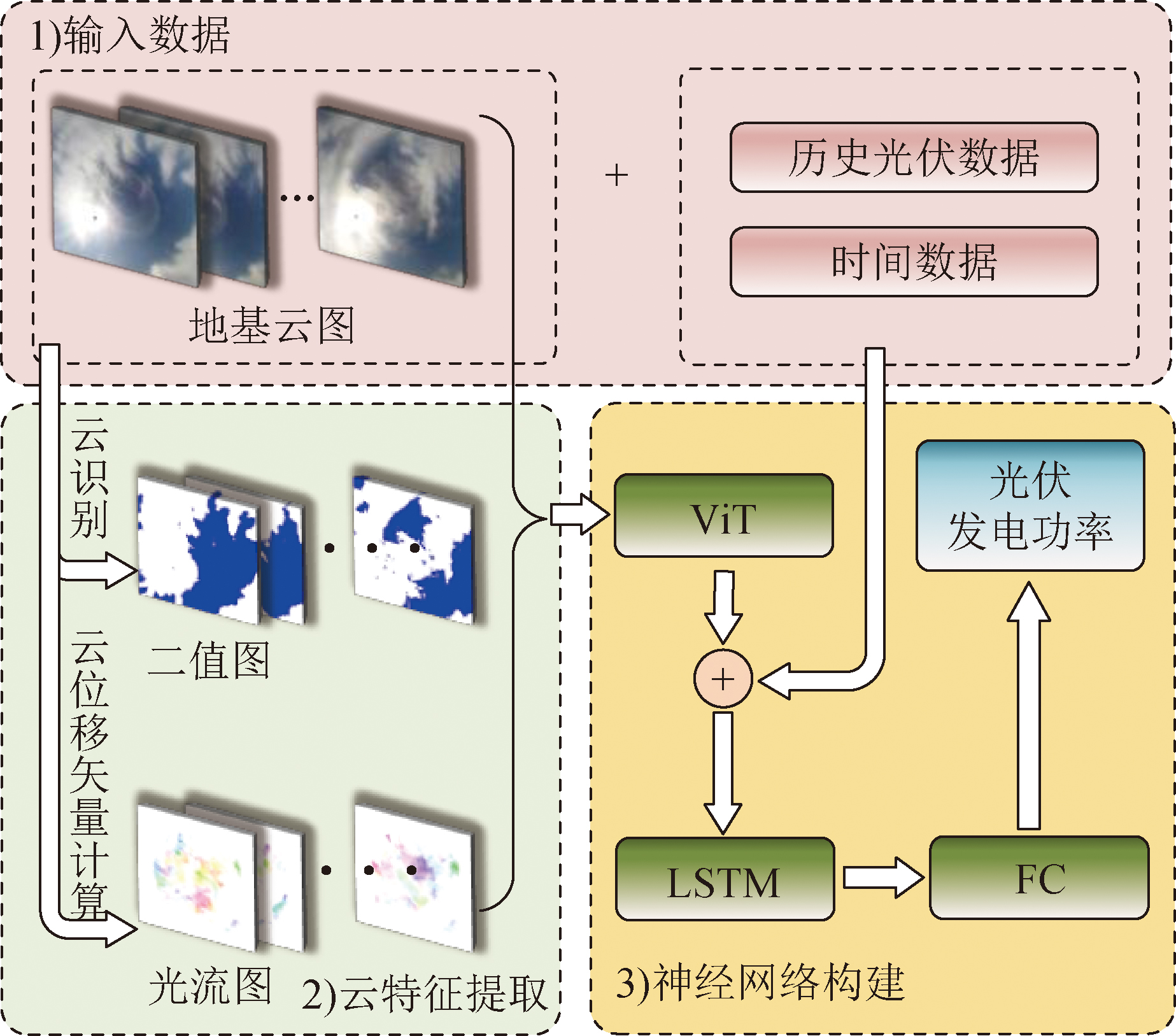
[Objective] To achieve accurate ultra-short-term photovoltaic power forecasting and address the insufficient extraction of cloud-information from ground-based sky images in traditional neural networks, this paper proposes an ultra-short-term photovoltaic power forecasting approach based on cloud features and a vision transformer+long short-term memory (ViT+LSTM) neural network. [Methods] First, an adaptive cloud recognition algorithm using Otsu’s method (OTSU) is adopted to generate high-accuracy binary images of cloud distribution. Second, a hybrid cloud‑motion‑vector algorithm is proposed, combining a similarity‑weighted cloud‑motion approach with the Farneback optical flow method to generate pixel‑level cloud‑displacement matrices. Ground‑based sky images, cloud distribution images and cloud motion matrices are concatenated to generate fused images. Finally, the ViT+LSTM neural network architecture is constructed for photovoltaic power forecasting. The ViT neural network extracts global spatial features from the fused images, and then global spatial features concatenated with historical photovoltaic power and temporal feature data are fed into LSTM neural network to capture temporal dynamic features. [Results] Case studies demonstrate that the approach effectively reduces cloud motion calculation error. The proposed approach achieves a 16.75% reduction in RMSE relative to the baseline model for ultra-short-term forecasting tasks. [Conclusions] The proposed cloud-feature extraction approach successfully extracts explicit cloud features, the proposed neural network architecture significantly outperforms existing models in forecasting performance; the proposed approach validates its accuracy in forecasting photovoltaic power fluctuations under different weather conditions.
photovoltaic power forecasting / deep learning / ground-based sky image / optical flow / vision transformer
| [1] |
|
| [2] |
International Renewable Energy Agency. Solar energy data[EB/OL]. (2021-04-17) [2025-07-20]. https://www.irena.org/solar.
|
| [3] |
饶志, 杨再敏, 杨雄平, 等. 基于地理和环境特征的光伏电站选址模型[J]. 电力建设, 2025, 46(7): 163-174.
|
| [4] |
胡烜彬, 纪正森, 许晓敏. DPCA-POA-RF-Informer在多情景光伏多步预测中的应用[J]. 智慧电力, 2024, 52(1): 8-13, 22.
|
| [5] |
|
| [6] |
张光儒, 马振祺, 陈杰, 等. 考虑降压节能和光伏误差三维特性的主动配电网多时间尺度优化调度[J]. 电力建设, 2024, 45(8): 159-172.
高比例分布式光伏的分散、随机特性加剧了配电系统潮流分布的不确定性,使得配电系统的安全经济运行面临严峻挑战。提出了考虑降压节能调节和分布式光伏预测误差三维特性的主动配电网多时间尺度优化调度方法。首先,分析负荷功率与馈线电压的灵敏度关系,提出了基于降压节能调节方法的综合负荷建模方法。其次,从时间-空间-功率三维角度,建立了一种分布式光伏预测误差的三维分析模型,为调度提供更精准的误差分析结果。然后,基于降压节能方法和预测误差三维分析模型,构建了可有效协调日前慢速调节资源与日内快速响应资源的主动配电网多时间尺度优化调度模型。最后,以改进IEEE 33节点系统为算例进行分析,算例分析结果表明所提误差建模方法对光伏功率有着较好的跟随效果,且基于该模型的优化调度策略能够减少误差随机性对调度决策的影响,提升配电系统运行的安全性与经济性。
The decentralized and random characteristics of high-proportion distributed photovoltaics aggravate the uncertainty of power flow distribution, which makes the safe and economic operation of the distribution system face severe challenges. In this paper, a multi-time scale optimization scheduling method for active distribution network considering the three-dimensional characteristics of conservation voltage reduction and distributed photovoltaic prediction error is proposed. Firstly, the sensitivity relationship between load power and feeder voltage is analyzed, and a comprehensive load modeling method based on step-down energy-saving regulation method is proposed. Then, from the perspective of time-space-power, a three-dimensional analysis model of distributed photovoltaic prediction error is established to provide more accurate error analysis results for scheduling. Finally, based on the conservation voltage reduction method and the three-dimensional analysis model of prediction error, a multi-timescale optimal scheduling model of active distribution network that can effectively coordinate the slow adjustment resources and the rapid response resources is constructed. Finally, taking the improved IEEE 33-node system as an example for analysis, the case study shows that the proposed error modeling method has a good following effect on photovoltaic power, and the optimized scheduling strategy based on this model can reduce the influence of error randomness on scheduling decision-making and improve the safety and economy of distribution system operation.
|
| [7] |
|
| [8] |
|
| [9] |
杨峻, 彭乔, 蔡永翔, 等. 考虑最大功率点估计模型校准的光伏功率备用控制[J]. 电力工程技术, 2024, 43(6): 12-20, 52.
|
| [10] |
|
| [11] |
|
| [12] |
|
| [13] |
|
| [14] |
唐雅洁, 龚迪阳, 林达, 等. 基于SAX-MHA-GCN的区域分布式光伏超短期功率预测[J]. 浙江电力, 2025, 44(8): 88-98.
|
| [15] |
马成廉, 韩瑞, 宋萌清, 等. 基于多源气象数据的光伏功率预测深度学习架构[J]. 电网与清洁能源, 2025, 41(4): 104-112.
|
| [16] |
黄晓燕, 郭洒洒, 陈成优, 等. 考虑时空关联及气象耦合的区域分布式光伏功率预测[J]. 浙江电力, 2025, 44(3): 79-89.
|
| [17] |
张静, 熊国江. 考虑季节特性与数据窗口的短期光伏功率预测组合模型[J]. 电力工程技术, 2025, 44(1): 183-192.
|
| [18] |
葛亚明, 戴上, 梁文腾, 等. 基于气象融合与深度学习的分布式光伏出力区间预测[J]. 电网与清洁能源, 2024, 40(8): 112-120.
|
| [19] |
陆毅, 薛枫, 唐小波, 等. 基于余弦相似度和TSO-BP的短期光伏预测方法[J]. 浙江电力, 2024, 43(6): 22-30.
|
| [20] |
|
| [21] |
|
| [22] |
|
| [23] |
|
| [24] |
|
| [25] |
|
| [26] |
A method for mapping color sky images of convective fair-weather cumuli to a scalar irradiance metric is presented. While basic interpretations of irradiance from color sky imagery are sufficient for many irradiance forecasting applications, sky images containing convective fair-weather cumuli can often contain gray-colored regions. Gray regions of a cloud commonly relate cloud thickness, indicating a region that has a high potential to attenuate surface irradiance from the sun. However, existing irradiance metrics are not found to translate such gray regions in accordance with their importance to a clear-sky index for short-term forecasting. This method exploits the special structure of sky images in three-dimensional red-green-blue (RGB) Cartesian space. By applying principal component analysis and basic clustering operations, a planar discriminant for cloudy-to-clear-sky classification is found. Once the {cloudy, clear-sky} identity of all image pixels is determined, the cloudy and clear-sky pixel distributions are separately remapped in RGB space so that gray pixels score a higher optical depth value than white pixels, and clear-sky pixels are mapped to low optical depth values. The resulting clear-sky index is simply the grayscale interpretation of the remapped image. The method is described and demonstrated with two actual sky images, and errors for sequences of several hundred images are tabulated and discussed. Remapped images are shown to represent gray cloud regions with a relatively high cloud optical depth in comparison with white cloud regions. The proposed metric is shown, by comparison with experimentally measured irradiance time series, to produce a more accurate clear-sky index in comparison with other methods.
|
| [27] |
|
| [28] |
|
| [29] |
|
| [30] |
王舒雨, 李豪, 马刚, 等. 基于TCN和DLinear的光伏发电功率多步预测模型[J]. 电力建设, 2025, 46(4): 173-184.
|
| [31] |
|
| [32] |
|
| [33] |
张一帆, 王宇强, 潘大志, 等. 基于云图数据的分布式光伏超短期功率预测方法研究[J]. 电网与清洁能源, 2025, 41(9): 110-115.
|
| [34] |
|
| [35] |
|
| [36] |
|
| [37] |
|
| [38] |
|
| [39] |
|
| [40] |
|
| [41] |
|
/
| 〈 |
|
〉 |