PDF(2734 KB)

Overview of Limiting Factors and Prospects for Systematic Evaluation of the External Transmission Capacity of Renewable Energy Base in Desert, Gobi and Barren Areas
LU Ting, ZHANG Jun, HAN Yijie
Electric Power Construction ›› 2026, Vol. 47 ›› Issue (3) : 119-134.
PDF(2734 KB)
 PDF(2734 KB)
Overview of Limiting Factors and Prospects for Systematic Evaluation of the External Transmission Capacity of Renewable Energy Base in Desert, Gobi and Barren Areas
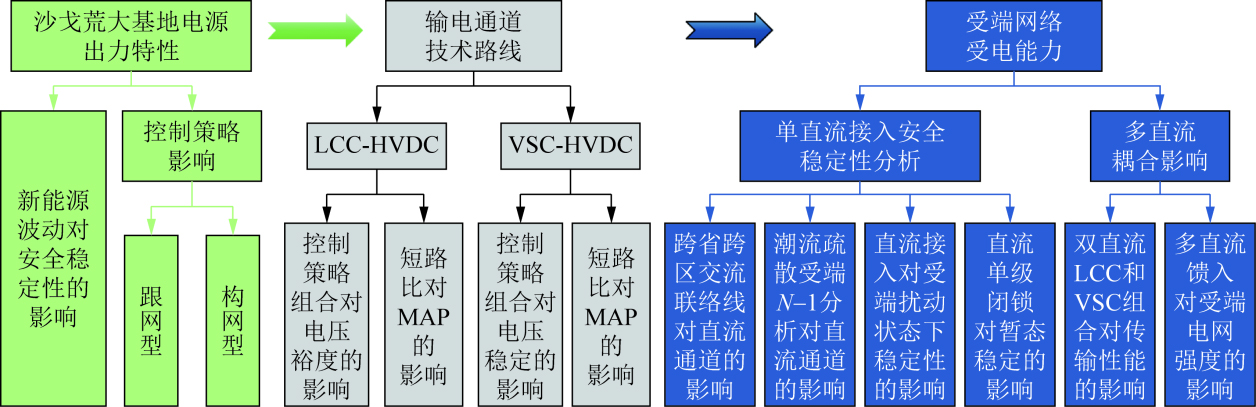
[Objective] With the construction of China’s new power system, renewable energy bases in desert, gobi and barren areas are gradually becoming crucial power suppliers. Based on the planned capacity of these bases, the actual power delivered to receiving-end grids is influenced by various external factors, involving different stakeholders across multiple stages. Therefore, for the complex system comprising multi-base sources, multi-channel transmission, and multi-receiving ends, evaluating the transmission capacity of any single base requires a comprehensive consideration of multiple factors. [Methods] This study analyzes the entire process of power transmission from the base power sources to the receiving-end grids via transmission channels. By reviewing existing research in each domain, various factors affecting the base’s power transmission capability are elaborated in detail. [Results] The transmission process can be divided into three stages: the base power source, the transmission channel, and the receiving-end grid. In the power source stage, fluctuations in renewable energy and grid-following and grid-forming technologies affect the active power output. In the transmission stage, control strategies of either conventional direct current transmission technology or flexible direct current transmission technology, along with the strength of both sending-end and receiving-end grids, determine the channel's maximum transmission capacity. In the receiving-end stage, single direct current feed-in, multi-direct current technology combination schemes, and multi-direct current coupling affect the receiving-end grid’s power acceptance capability. A comprehensive assessment of the base’s transmission capacity must integrate the aforementioned factors. [Conclusions] The proposed systematic evaluation method can promote collaborative efforts among stakeholders across different stages. By comprehensively considering the constraints of base capacity planning and transmission-affecting factors, this method provides technical insights and references for accurately assessing the transmission capability of complex systems involving renewable energy bases in desert, gobi and barren areas.
desert, gobi and barren areas / renewable energy base / ultra high voltage direct current transmission / power receiving capacity of the receiving grid
| [1] |
第一批以沙漠、戈壁、荒漠地区为重点的大型风电光伏基地建设项目清单的通知:发改办能源[2021]926号[A]. 北京: 国家发展和改革委员会国家能源局, 2021.
|
| [2] |
第二批以沙漠、戈壁、荒漠地区为重点的大型风电光伏基地建设项目清单的通知[A]. 北京: 国家发展和改革委员会国家能源局, 2022.
|
| [3] |
第三批以沙漠、戈壁、荒漠地区为重点的大型风电、光伏基地建设项目清单的通知[A]. 北京: 国家发展和改革委员会国家能源局, 2023.
|
| [4] |
关于委托开展“十四五”规划输电通道配套水风光及调节电源研究论证的函[A]. 北京: 国家能源局, 2022.
|
| [5] |
杨寅平, 王绍德, 孙英云, 等. 计及受端电网可信及调峰需求的大型风光储基地运行及规划方法: (一)中长期运行优化[J]. 高电压技术, 2025, 51(2): 547-557.
|
| [6] |
刘斌, 张玉琼, 麻林巍, 等. 西北地区源端基地综合能源系统的技术方案设计及优化研究[J]. 中国电机工程学报, 2021, 41(2): 568-580.
|
| [7] |
赵星源, 肖晋宇, 赵丹, 等. 自适应蚁群算法的清洁能源基地选址优化模型[J]. 测绘科学, 2021, 46(4): 172-177.
|
| [8] |
甘磊. 考虑大型新能源发电基地接入的大电网规划方法研究[D]. 北京: 华北电力大学, 2017.
|
| [9] |
孙严冬, 李杰, 吉日格图, 等. 风-光-火-储多能互补基地电力外送及消纳方案研究[J]. 内蒙古电力技术, 2023, 41(5): 62-68.
|
| [10] |
李宏斌, 郭怿, 魏立保, 等. 黄河上游风电光伏互补性量化评估及容量配比研究[J]. 电网与清洁能源, 2024, 40(7): 139-145.
|
| [11] |
陆晶晶, 贺之渊, 赵成勇, 等. 直流输电网规划关键技术与展望[J]. 电力系统自动化, 2019, 43(2): 182-191.
|
| [12] |
刘增训, 游沛羽, 周勤勇. 适用高比例新能源系统广域消纳的输电技术研究综述[J]. 电力工程技术, 2020, 39(5): 59-70.
|
| [13] |
周建力. 风-光-氢综合能源系统容量配置优化及决策模型研究[D]. 北京: 华北电力大学, 2022.
|
| [14] |
王秀丽, 武泽辰, 曲翀. 光伏发电系统可靠性分析及其置信容量计算[J]. 中国电机工程学报, 2014, 34(1): 15-21.
|
| [15] |
丁坤, 孙亚璐, 王湘, 等. 考虑置信容量和调峰能力的新能源基地光热电站配置方法[J]. 广东电力, 2024, 37(3): 25-34.
|
| [16] |
魏韡, 范越, 谢睿, 等. 平抑高比例新能源发电功率波动的风-光-储容量最优配比[J]. 电力建设, 2023, 44(3): 138-147.
发展新能源是应对环境污染和能源危机的根本性措施,有助于推动“双碳”目标的实现。可再生能源发电固有的间歇性、波动性给电网规划和运行带来严峻挑战。针对高比例新能源电力系统,分析了以最小功率波动为目标的新能源和储能容量最佳配比。立足风光资源的互补性,构建了最小化系统功率波动的风光最优配比模型,并提出了基于线性规划的求解算法。最后建立了面向平滑新能源出力的储能容量配置参数线性规划模型,得到波动性指标关于储能容量的解析表达式,并根据成本确定了最优储能容量。所提方法为政策制定提供了可视化工具以及比单一最优解更加丰富的信息。
The development of renewable energy is a fundamental measure to resolve environmental pollution and energy crisis, and achieve the carbon peaking and carbon neutrality goals. However, the inherent volatility and fluctuation of renewable energy output bring unprecedented challenges to the planning and operation of the power grid. This paper studies the optimal ratio of renewable energy and energy storage, aiming to minimize power fluctuation. According to the complementary nature of wind and solar resources, the mode of optimal ratio of wind and solar power that leads to minimal power fluctuation is established and is further transformed into linear programming. The optimization problem of energy storage capacity aiming to smooth the renewable energy output is formulated as a multi-parameter linear program, where storage charging power and energy capacities are parameters. The power fluctuation index is expressed as an analytical function in storage parameters, which is convex and piecewise linear. On the basis of the fluctuation index function, the optimal storage capacities can be determined according to the costs. The proposed method provides an illustrative tool and more abundant information for policy and decision-making. |
| [17] |
谭玲玲, 张文龙, 康志豪, 等. 计及惯量响应与一次调频参数优化的新能源基地构网型储能规划[J]. 中国电力, 2025, 58(7): 147-161.
|
| [18] |
康健, 王筱. 青海海西柴达木沙漠新能源基地风光容量配比优化研究[J]. 西北水电, 2024(3): 108-113.
|
| [19] |
黄碧斌, 孟子涵, 冯凯辉, 等. 考虑可再生能源不确定性的风-光-储容量最优配比[J]. 水力发电, 2024, 50(12): 94-99, 111.
|
| [20] |
姜梦妍, 王筱, 董闯, 等. 基于时序运行模拟的水火风光储互补系统电源优化配置[J]. 水力发电学报, 2024, 43(3): 71-83.
|
| [21] |
李思能, 刘志勇, 曾庆彬. 高比例新能源接入的输电网外送通道与储能分布鲁棒优化协同规划方法[J]. 广东电力, 2024, 37(1): 49-59.
|
| [22] |
李湃, 卢慧, 李驰, 等. 多能互补发电系统电/热储能容量双层优化配置方法[J]. 中国电力, 2025, 58(3): 55-64.
|
| [23] |
程浩忠, 李隽, 吴耀武, 等. 考虑高比例可再生能源的交直流输电网规划挑战与展望[J]. 电力系统自动化, 2017, 41(9): 19-27.
|
| [24] |
贺海磊, 张彦涛, 孙骁强, 等. 考虑频率安全约束的西北电网新能源开发及直流外送规模评估方法[J]. 中国电机工程学报, 2021, 41(14): 4753-4762.
|
| [25] |
邹桂林. 计及多重随机因素的区域间可用输电能力评估及优化决策[D]. 广州: 华南理工大学, 2024.
|
| [26] |
罗昊. 面向数字孪生的电-气综合能源系统可用输电能力计算[D]. 吉林: 东北电力大学, 2023.
|
| [27] |
张昭阳. 计及风光不确定性的区域间可用输电能力概率评估[D]. 重庆: 重庆理工大学, 2023.
|
| [28] |
陈金富, 孙鑫, 段献忠, 等. 基于机会约束规划的含风电场电力系统可用输电能力计算[J]. 中国电机工程学报, 2019, 39(23): 6804-6814, 7094.
|
| [29] |
鲍颜红, 张金龙, 江叶峰, 等. 考虑新能源出力不确定性的可用输电能力在线评估方法[J]. 电力自动化设备, 2020, 40(4): 71-76.
|
| [30] |
刘晓颖, 郭春义, 迟永宁. 不同风光水配比下多类型电源打捆直流外送系统的功率传输能力研究[J]. 中国电机工程学报, 2024, 44(13): 5051-5062.
|
| [31] |
张艳, 张旭, 张静怡, 等. 考虑风电不确定性的沙戈荒新能源基地交直流混合外送系统最大传输能力评估[J]. 电力建设, 2024, 45(12): 174-186.
|
| [32] |
陈国平, 李明节, 许涛, 等. 关于新能源发展的技术瓶颈研究[J]. 中国电机工程学报, 2017, 37(1): 20-27.
|
| [33] |
李明, 常永康, 毛永涛, 等. 高渗透率新能源发电并网变流器跟网/构网型稳定控制技术综述与展望[J]. 高电压技术, 2024, 50(11): 4773-4788.
|
| [34] |
万易, 王建, 南东亮, 等. 基于变流器并网的新能源外送系统功率传输能力评估[J]. 电网技术, 2024, 48(1): 171-183.
|
| [35] |
于彦雪, 胡鹏飞, 陈玉树, 等. 极弱电网下并网逆变器功率传输能力分析及提升方法[J]. 电力系统自动化, 2022, 46(14): 101-108.
|
| [36] |
谢小荣, 贺静波, 毛航银, 等. “双高”电力系统稳定性的新问题及分类探讨[J]. 中国电机工程学报, 2021, 41(2): 461-475.
|
| [37] |
张恒旭, 马睿聪, 曹永吉, 等. 新型电力系统同步稳定研究综述及展望[J]. 山东大学学报(工学版), 2025, 55(2): 1-15.
|
| [38] |
许诘翊, 刘威, 刘树, 等. 电力系统变流器构网控制技术的现状与发展趋势[J]. 电网技术, 2022, 46(9): 3586-3594.
|
| [39] |
彭程, 阳岳希, 高冲, 等. 跟网型和构网型变流器动态电压支撑技术综述[J]. 高电压技术, 2025, 51(8): 3810-3825.
|
| [40] |
王祺, 张泽轲, 郭杰帅, 等. 新型电力系统主动构网机理与技术路径[J]. 中国电机工程学报, 2024, 44(2): 504-516.
|
| [41] |
周于清, 姚伟, 宗启航, 等. 基于运行短路比的新能源场站中跟构网可切换单元的最优配置方法[J]. 电网技术, 2024, 48(3): 1091-1102.
|
| [42] |
王冠淇, 裴玮, 熊佳旺, 等. 跟网型和构网型变流器混合系统稳定性分析方法[J]. 中国电机工程学报, 2025, 45(1): 25-37.
|
| [43] |
罗澍忻, 韩应生, 余浩, 等. 构网型控制在提升高比例新能源并网系统振荡稳定性中的应用[J]. 南方电网技术, 2023, 17(5): 39-48.
为了研究能够支撑新能源系统稳定运行的构网型与跟网型机组间比例关系,首先以单风场并网系统为例,分析了跟网型和构网型机组的并网动态特性;然后从保持并网风场在低频和次同步频段内振荡稳定性的角度,提出了风场内配置构网型机组容量的计算原则;在此基础上基于三机九节点算例系统,探究了100%新能源构成系统稳定运行的可行性,研究了系统内构网型机组的比例和位置等因素对系统动态特性的影响。研究表明,在风场内配置少量构网型机组即可有效改善弱电网下风场的次同步振荡问题,场内构网型机组的配置容量主要受低频模态稳定性的约束;在100%新能源系统内,构网型控制对远端跟网型机组支撑不足导致的次同步振荡是决定构网型控制需求的关键约束。
In order to study the ralationship between grid-forming (GFM) and grid-following (GFL) units that can support the stable operation of renewable systems, this paper firstly takes the single wind farm integrated system as an example to analyze the dynamic characteristics of the GFL and GFM units. Then, from the perspective of maintaining the oscillation stability of wind farms both in low frequency and subsynchronous frequency bands, the calculation principle of the GFM unit capacity to be deployed in wind farms is proposed. On this basis, based on the three-machine-nine-bus system, the feasibility of the stable operation of the 100% renewable system is explored, and the influence of the proportion and location of the GFM units on the dynamics of the system are studied. The results show that the subsynchronous oscillation (SSO) risk can be effectively improved by deploying a small number of GFM units in the wind farm, and the capacity of GFM units is mainly constrained by the low-frequency mode stability. Besides, in the 100% renewable system, the SSO due to inadequate support of GFM to the remote GFL units is the key constraint in determining the need for GFM units. |
| [44] |
刘振亚, 张启平, 董存, 等. 通过特高压直流实现大型能源基地风、光、火电力大规模高效率安全外送研究[J]. 中国电机工程学报, 2014, 34(16): 2513-2522.
|
| [45] |
曾嵘, 屈鲁, 余占清, 等. 支撑新能源送出的新型直流换流技术[J]. 高电压技术, 2025, 51(8): 4194-4208.
|
| [46] |
辛保安, 郭铭群, 王绍武, 等. 适应大规模新能源友好送出的直流输电技术与工程实践[J]. 电力系统自动化, 2021, 45(22): 1-8.
|
| [47] |
冯俊杰, 辛清明, 赵晓斌, 等. 大规模新能源超远距离送出的柔性直流系统集成设计方案[J]. 南方电网技术, 2024, 18(3): 34-44.
沙漠、戈壁、荒漠等地区大规模新能源输送负荷中心是实现“碳达峰、碳中和”目标的重要举措。介绍了基于常规直流和柔性直流的大规模新能源超远距离送出方案,从适用场景、过电压、电压与无功功率调节能力、经济性等方面对比了两种方案的优劣,柔性直流送出方案具有较好的技术经济优势。提出了适用于千万千瓦级新能源基地超远距离送出的柔性直流系统集成设计方案,包括±800 kV/10 GW四端柔性直流输电系统的电气主接线、主回路参数、协调控制策略、交直流卸荷装置配置等。研究了双极单阀组和高低阀组方案选择、送端多阀组交流电压协同控制、高低阀组直流电压平衡控制等关键技术,提出了交直流卸荷装置的配置方案及投切策略。基于电磁暂态仿真验证了所提柔性直流设计方案的有效性。
Large-scale renewable energy transmission from desert, Gobi and wilderness to load centers is critical measure to achieve the goals of "Carbon Peak and Carbon Neutrality". Two large-scale renewable energy ultra-long-distance transmission schemes are introduced, including line commutated converter based high voltage direct current (LCC-HVDC) and voltage source convert based high voltage direct current (VSC-HVDC). The two schemes are compared in terms of their applicable scenarios, overvoltage, voltage and reactive power adjustment capabilities, and economy, to highlight their respective advantages and disadvantages. VSC-HVDC is superior in terms of technology and economy. An integrated design scheme of ±800 kV/10 GW four-terminal VSC-HVDC system for 10 gigawatt renewable energy ultra-long-distance transmission is proposed, which includes the electrical main wiring, main circuit parameters, coordinated control strategy, and the configuration of AC/DC choppers. Key technologies such as bipolar single-valve and high-low valve scheme selection, AC voltage coordinated control of multi-valve at the sending end, and DC voltage balance control of high-low valve are studied, and the configuration scheme and switching strategy of the configuration of AC/DC choppers are proposed. The effectiveness of the HVDC transmission system scheme is verified through electromagnetic transient simulation. |
| [48] |
李晖, 盖振宇, 蔡东阳, 等. 计及直流系统影响的交直流受端电网静态电压稳定分析[J]. 南方电网技术, 2021, 15(5): 12-19.
|
| [49] |
胡艳梅, 吴俊勇, 李芳, 等. ±800kV哈郑特高压直流控制方式对河南电网电压稳定性影响研究[J]. 电力系统保护与控制, 2013, 41(21): 147-153.
|
| [50] |
王思成. 多馈入高压直流输电系统安全评估与优化调度研究[D]. 南京: 东南大学, 2022.
|
| [51] |
沙江波, 赵成勇, 王庆, 等. 同步调相机对特高压直流输电系统最大传输功率的影响[J]. 高电压技术, 2019, 45(11): 3627-3634.
|
| [52] |
罗钢, 刘崇茹, 李欣蔚, 等. 送受端系统短路比关系对直流输电系统最大输送功率的影响[J]. 现代电力, 2018, 35(4): 45-51.
|
| [53] |
饶宏, 黄伟煌, 郭铸, 等. 提升受端电网稳定性的主动支撑型柔性直流的形态、关键技术与展望[J]. 中国电机工程学报, 2024, 44(17): 6818-6830.
|
| [54] |
李周, 王宇涵, 顾伟, 等. 直流电网及其运行控制策略发展趋势[J]. 电力系统自动化, 2024, 48(24): 1-21.
|
| [55] |
武兴龙. VSC-HVDC系统的机电暂态建模与电压支撑作用研究[D]. 杭州: 浙江大学, 2023.
|
| [56] |
陈泽伟. 含VSC-HVDC的交直流系统直接法暂态稳定分析[D]. 南京: 南京理工大学, 2023.
|
| [57] |
刘昇, 徐政. 联于弱交流系统的VSC-HVDC稳定运行区域研究[J]. 中国电机工程学报, 2016, 36(1): 133-144.
|
| [58] |
贺永杰. 可再生能源经混合级联直流外送系统的控制与小干扰稳定性研究[D]. 武汉: 华中科技大学, 2024.
|
| [59] |
马富艺龙, 辛焕海, 刘晨曦, 等. 新能源基地柔性直流送出系统小扰动电压支撑强度评估[J]. 电工技术学报, 2023, 38(21): 5758-5770, 5938.
|
| [60] |
王奕鑫, 刘晓颖, 汪莹, 等. 基于广义短路比的LCC/VSC混合多馈入系统小干扰稳定分析[J/OL]. 中国电机工程学报,1-16.[2026-01-04]. https://link.cnki.net/urlid/11.2107.tm.20250625.1642.004.
|
| [61] |
刘炜. 适用于VSC-HVDC连接极弱受端交流电网的功率阻尼同步控制方法研究[D]. 北京: 华北电力大学, 2016.
|
| [62] |
郑超, 马世英, 申旭辉, 等. 强直弱交的定义、内涵与形式及其应对措施[J]. 电网技术, 2017, 41(8): 2491-2498.
|
| [63] |
杨丹, 刘静, 朱军飞, 等. 湖南电网交直流受电能力分析及提升方案[J]. 电气应用, 2019, 38(4): 102-109.
|
| [64] |
王莹. 特高压直流接入交流电网的相关问题研究[D]. 武汉: 华中科技大学, 2016.
|
| [65] |
赵理威. 用于提高新能源消纳的多馈入直流系统分析[D]. 乌鲁木齐: 新疆大学, 2017.
|
| [66] |
李兆伟, 翟海保, 刘福锁, 等. 华东大受端电网直流接入能力评估[J]. 电力系统自动化, 2016, 40(16): 147-152.
|
| [67] |
郭小江, 郭剑波, 马世英, 等. 基于多馈入短路比的多直流落点选择方法[J]. 中国电机工程学报, 2013, 33(10): 36-42.
|
| [68] |
龙志, 杨柳, 姚文峰. 广东电网远景直流落点优化研究[J]. 电力系统保护与控制, 2016, 44(10): 145-150.
|
| [69] |
边宏宇, 徐友平, 邵德军, 等. 直流馈入受端电网“空心化”形势下的稳定特性分析及解决措施[J]. 电力系统保护与控制, 2020, 48(18): 164-170.
|
| [70] |
李华取, 彭晓涛, 覃琴, 等. 基于多目标优化的电网直流承载规模评估方法[J]. 电网技术, 2021, 45(8): 3115-3124.
|
| [71] |
蒲天骄, 赵琦, 王新迎. 电力人工智能技术研究框架、应用现状及展望[J]. 电网技术, 2025, 49(5): 1751-1770.
|
| [72] |
谢天晗, 郭春义, 张加卿. 跟网-构网混合型风光新能源并网系统的功率稳定传输范围[J/OL]. 中国电力,1-12.[2026-01-05]. https://link.cnki.net/urlid/11.3265.TM.20251013.1614.002.
|
| [73] |
陈仕原, 林舜江, 杨悦荣, 等. 新能源基地经柔性直流送出系统的构网型变流器优化配置方法[J/OL]. 高电压技术,1-12.[2026-01-05].https://doi.org/10.13336/j.1003-6520.hve.20250379.
|
| [74] |
杨志强, 王仙荣, 邹凯凯, 等. 海上风电柔直系统中频振荡抑制方法及工程验证[J]. 电力工程技术, 2025, 44(5): 109-116.
|
| [75] |
李岩, 辛清明, 杨子千, 等. 大规模新能源经柔性直流孤网送出系统的稳定新问题与控制方法[J]. 高电压技术, 2025, 51(11): 5354-5366.
|
| [76] |
张兆洋, 高丙团, 索之闻, 等. 柔性直流输电系统支撑新能源送端频率稳定的自适应双下垂控制策略[J]. 电力建设, 2025, 46(5): 1-11.
|
| [77] |
陈玮, 余志军, 刘方, 等. 直流承载能力评估方法与提升策略研究综述[J]. 广东电力, 2025, 38(7): 41-54.
|
| [78] |
邓步青. 受端电网直流承载能力评估方法与提升策略研究[D]. 长沙: 湖南大学, 2023.
|
/
| 〈 |
|
〉 |