PDF(8938 KB)

Real-Time Charging Navigation Strategy for Expressway Electric Vehicles Considering Secondary Road Network, Regional Distribution Network and Fast Charging Station
JI Chenlin, YANG Qiming, LIU Youbo, XING Qiang, TANG Difei, LIU Dafu
Electric Power Construction ›› 2026, Vol. 47 ›› Issue (8) : 161-175.
PDF(8938 KB)
 PDF(8938 KB)
Real-Time Charging Navigation Strategy for Expressway Electric Vehicles Considering Secondary Road Network, Regional Distribution Network and Fast Charging Station
[Objective] With the increasing continuous increase in electric vehicle penetration, the mismatch between charging resources and demand on expressways during peak travel periods is becoming increasingly prominent. To address this issue, this paper proposes a real-time charging navigation strategy for the entire charging process on expressways, considering secondary roads, regional distribution networks, and fast-charging stations within the secondary road network. [Methods] First, the expressway network considering secondary road networks, charging behavior of drivers, and the secondary distribution network are modeled based on the physical characteristics of the expressway network. Then, the multi-dimensional factors influencing users’ charging navigation decisions are converted into a multi-level road comprehensive impedance based on individual preferences, establishing a personalized dynamic road resistance (PDRR) model. Finally, through a two-stage real-time charging guidance, the navigation scheme is optimized with the goal of enhancing users' overall charging experience on the expressway network. In the first stage, the fast-charging station with the lowest comprehensive road resistance is preliminary selected based on real-time network information. In the second stage, an improved Floyd-Warshall algorithm is used to identify the route with the lowest weight in the PDRR model in real time and update it accordingly. Both stages incorporate individual preferences and real-time traffic information affecting various key factors of the user charging experience. [Results] Simulation results based on a real multi-level road network show that, compared with the strategy considering only the pure expressway road network, incorporating the secondary "road-network-station" factors reduces the average charging time of each charging station during peak hours by 53.97%, and increases the overall matching degree between the guidance scheme and user demand by 1.96%. [Conclusions] The proposed real-time charging navigation strategy can effectively reduce the overall charging cost, alleviate charging congestion on the expressway network during peak periods, and significantly improve the operational economy and reliability of fast charging stations.
electric vehicle / multi-level expressway network / regional distribution network / secondary fast charging station / charging navigation
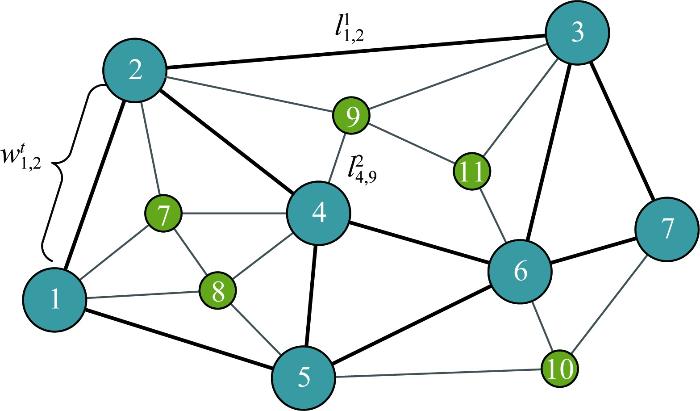
图A1展示了计及次级路网高速交通网的拓扑结构,其包含高速路网和次级路网节点、高速和次级路段和综合道路阻抗元素。基于图论的路网建模如下:
式中:Gn为计及次级路网的高速路网图模型;V为Gn中的路网节点集合;L1为高速道路集合;L2为次级道路集合;W为综合路阻
图A1 计及次级路网的高速路网拓扑Fig.A1 Expressway network topology considering secondary road network |
对于高速路网中的第x辆EV,其初始SOC等出行参数采用蒙特卡罗方法抽取:
式中:ts,x和te,x分别为第x辆电动汽车出发和到达时刻;Ot,x和Dt,x分别为第x辆电动汽车出行的出发点和到达点的集合。
可采用马尔可夫状态转移矩阵[9]对电动汽车在各高速路网节点的转移概率进行表述:
式中:对角线元素为车辆不移动的概率,非对角线元素为车辆由原路段节点转移到各新节点的概率。采用 Dijkstra算法用于寻找电动汽车出发点到目的地的最优行驶路径。完成这段驾驶后,更新模拟时间t。通过反复使用该概率矩阵,可以描述电动汽车在高速路网上的出行特征。
充放电次数的增加必然导致电池实际容量的衰退。根据EV数据库中的容量数据,可拟合出一个合适的概率密度函数来模拟实际电池容量分布:
式中:μ=23.0,σ=9.5。当电池容量为9.6~72 kW·h,初始SOC为0~1时,电动汽车的初始电量可计算为:
快充站参数设定:共计6座高速路网快充站和12座次级路网快充站分别位于高速路网节点1、7、12、23、30、43和次级路网节点3、5、8、12、13、16、18、22、27、28、33、35、38附近。快充站是交通网与电网耦合的主要接口,本文中各快充站按地理分布,分别接入4个不同配电网供电节点,其具体对应关系及充电桩个数见附表C1。
表C1 快充站与配电网节点对应关系及充电桩数量Table C1 Correspondence between fast charging station and distribution network node and the number of charging piles |
| 充电站所在路网节点 | 充电站所在配网 | 充电站所在配网节点 | 充电桩数量 | 充电站所在路网节点 | 充电站所在配网 | 充电站所在配网节点 | 充电桩数量 |
|---|---|---|---|---|---|---|---|
| 1 | 1 | 3 | 16 | 22 | 3 | 25 | 10 |
| 3 | 1 | 17 | 10 | 23 | 3 | 3 | 16 |
| 5 | 1 | 32 | 10 | 27 | 3 | 17 | 8 |
| 7 | 1 | 1 | 16 | 28 | 4 | 32 | 8 |
| 8 | 2 | 25 | 10 | 30 | 4 | 3 | 16 |
| 12 | 2 | 3 | 16 | 33 | 4 | 32 | 10 |
| 13 | 2 | 17 | 10 | 35 | 4 | 17 | 10 |
| 16 | 2 | 32 | 6 | 38 | 1 | 25 | 10 |
| 18 | 3 | 31 | 10 | 43 | 2 | 1 | 16 |
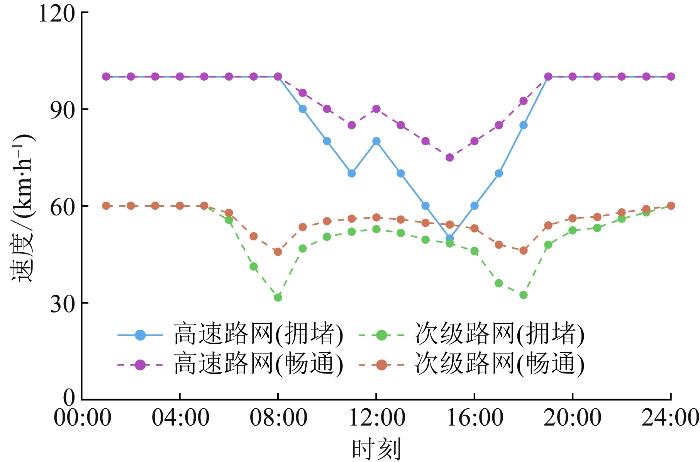
多级路网参数设定:70条道路可按路段等级和实时路况被分为高速路网(拥堵)、高速路网(畅通)、次级路网(拥堵)、次级路网(畅通)4种类型,路段起止节点和具体路况类型的对应关系见附表C2,各类型路况对应的实时路况曲线见附图C1。
表C2 路况类型对应关系Table C2 Road condition type correspondence |
| 起始节点 | 终止节点 | 路况类型 | 起始节点 | 终止节点 | 路况类型 | 起始节点 | 终止节点 | 路况类型 |
|---|---|---|---|---|---|---|---|---|
| 1 | 2 | 高速拥堵 | 12 | 13 | 次级拥堵 | 26 | 28 | 次级畅通 |
| 1 | 20 | 高速畅通 | 12 | 14 | 高速拥堵 | 27 | 29 | 次级拥堵 |
| 2 | 3 | 次级拥堵 | 12 | 34 | 高速畅通 | 27 | 30 | 次级畅通 |
| 2 | 4 | 高速畅通 | 13 | 14 | 次级拥堵 | 28 | 30 | 次级拥堵 |
| 2 | 5 | 次级畅通 | 14 | 35 | 次级拥堵 | 28 | 31 | 次级拥堵 |
| 2 | 20 | 高速畅通 | 14 | 36 | 次级拥堵 | 28 | 32 | 次级畅通 |
| 3 | 4 | 次级畅通 | 14 | 42 | 高速拥堵 | 29 | 30 | 高速畅通 |
| 4 | 5 | 次级畅通 | 15 | 16 | 次级畅通 | 30 | 31 | 高速畅通 |
| 4 | 6 | 高速拥堵 | 15 | 24 | 次级拥堵 | 31 | 39 | 高速畅通 |
| 5 | 15 | 次级拥堵 | 16 | 17 | 次级畅通 | 32 | 37 | 次级畅通 |
| 5 | 22 | 次级畅通 | 17 | 18 | 次级拥堵 | 33 | 34 | 次级畅通 |
| 6 | 7 | 高速拥堵 | 17 | 25 | 高速畅通 | 34 | 35 | 次级畅通 |
| 6 | 15 | 次级拥堵 | 18 | 19 | 次级拥堵 | 34 | 37 | 高速畅通 |
| 7 | 8 | 次级畅通 | 18 | 26 | 次级畅通 | 35 | 36 | 次级畅通 |
| 7 | 9 | 高速拥堵 | 19 | 33 | 次级畅通 | 35 | 37 | 次级畅通 |
| 7 | 16 | 次级拥堵 | 20 | 21 | 高速畅通 | 36 | 38 | 次级畅通 |
| 7 | 17 | 次级畅通 | 20 | 22 | 次级畅通 | 36 | 41 | 次级畅通 |
| 8 | 9 | 次级畅通 | 21 | 22 | 次级畅通 | 37 | 38 | 次级畅通 |
| 9 | 10 | 高速拥堵 | 21 | 23 | 高速畅通 | 37 | 40 | 高速畅通 |
| 9 | 18 | 次级畅通 | 22 | 24 | 次级拥堵 | 39 | 40 | 高速拥堵 |
| 10 | 11 | 高速拥堵 | 23 | 29 | 高速畅通 | 40 | 41 | 高速拥堵 |
| 10 | 19 | 次级畅通 | 24 | 27 | 次级畅通 | 41 | 42 | 高速拥堵 |
| 11 | 12 | 高速拥堵 | 25 | 30 | 高速畅通 | 42 | 43 | 高速拥堵 |
| 11 | 33 | 次级畅通 |
电动汽车设置:本文选用比亚迪元plus(电池容量:49.92 kWh,高速路网平均电耗:15 kWh/100 km,次级路网平均电耗:12 kWh/100 km)作为仿真车型。由于电池可能存在容量衰减退化,电动汽车的实际容量为正态分布(45,9.5),范围为40~47.3 kWh,初始荷电状态采用范围为0至1的均匀分布。参与模拟的电动汽车总数为2000辆,可分为4种类型:类型1,距离敏感型用户,主要偏好为避免里程焦虑;类型2,时间敏感型用户,主要偏好为减少总行程时间;类型3,价格敏感型用户,主要偏好为减少总充电费用;类型4,均衡型用户,在距离、时间和费用3个主要指标上有相同的偏好,4种类型的电动汽车数量分别为400、500、500、600。综合电池容量、充电功率、高速平均时速等数据,计算满电场景下,用户在高速路网单次行驶时长及充电时长均未满足交通安全法规要求,因此本文设定用户可在车辆充电的同时得到充分休息。
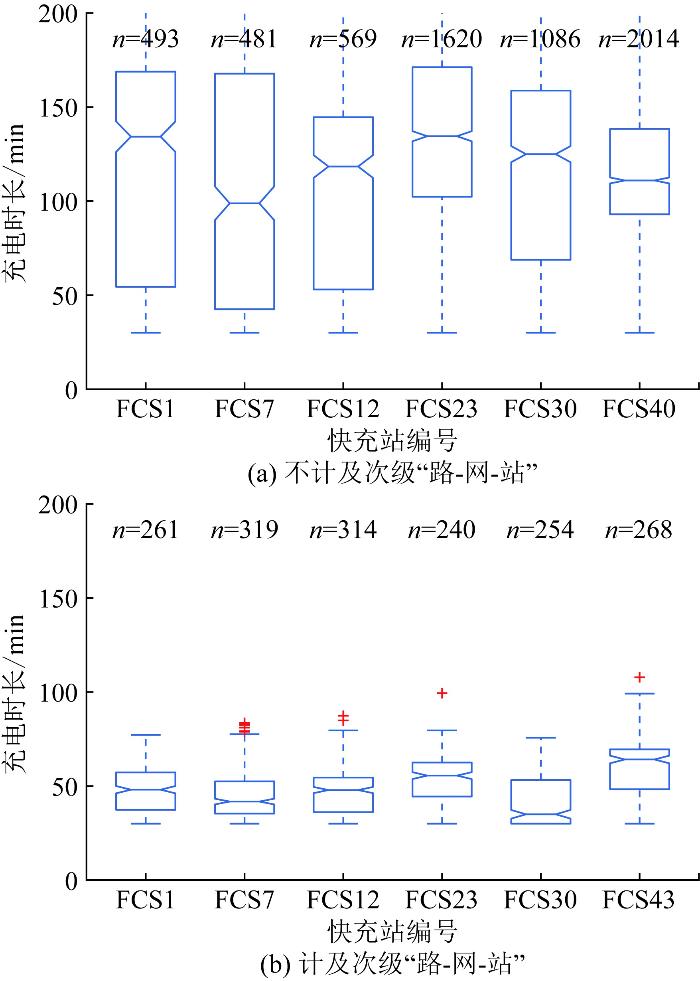
充电时间数据进一步佐证了计及次级“路-网-站”因素的对充电拥堵现象缓解的有效性。图D1给出了各高速路网快充站平均充电花费时间箱线图。以FCS7为例,不计及次级“路-网-站”因素时,其充电时间四分位数范围为91.5~163.4 min,而在计及次级“路-网-站”因素时,该指标范围仅为53.7~76.8 min,表明排队时长得到有效缓解。
图D1 各高速路网快充站平均充电花费时间Fig.D1 Average charging time of fast charging stations on various expressway networks |
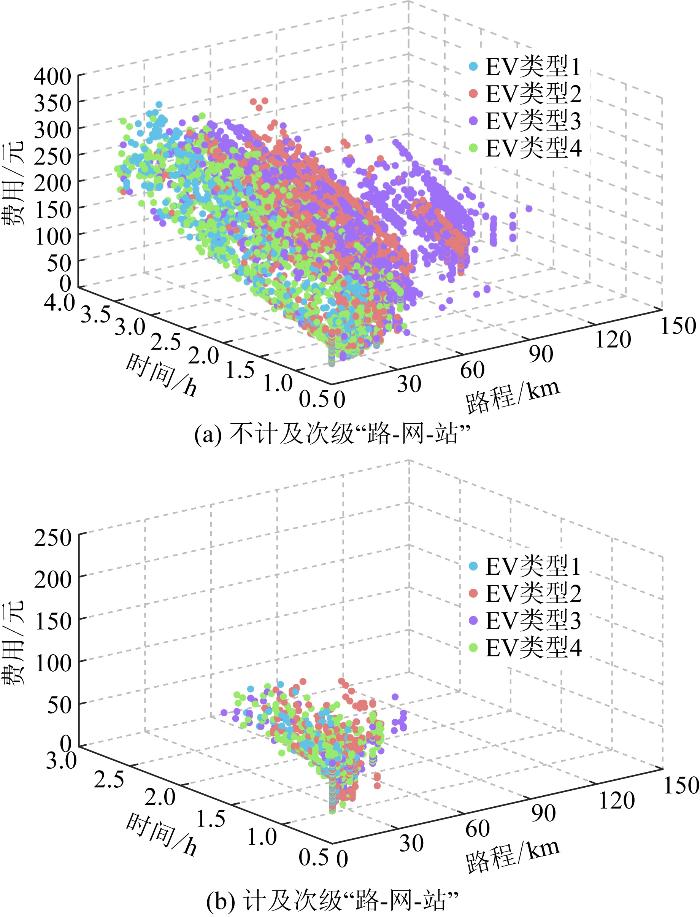
图D2给出了计及次级“路-网-站”因素前后的充电决策结果对比,图中蓝、橙、紫和绿4种颜色圆点分别表示4种类型EV分别基于各自需求偏好做出的充电决策结果在充电距离、充电时间、总经济成本三个维度上的数据分布。
图D2 用户的充电行为三维数据分析Fig.D2 Number of vehicles waiting and charging in fast charging stations |
分析图D2(a)中的结果可以看出,偏好最短距离的类型1用户充电距离最短,与之对应的是显著增加的充电时间和经济成本;偏好最低费用的类型3用户付出了额外的路程和时间成本。综合分析可以得到以下结论:1)充电时间和充电距离在一定程度上呈正相关,而充电距离与充电费用呈负相关;2)与充电决策相关的三个因素是相互耦合的,仅以满足单一因素为目标进行优化将不可避免地导致其他因素的成本上升。
图D2(b)引入次级路网因素后,各类型用户的充电需求在3个维度上的分布均实现了降低,这表明了次级路网引入分流作用并不局限于特定类型用户,由于充电拥堵的缓解,所有类型用户均可受益。
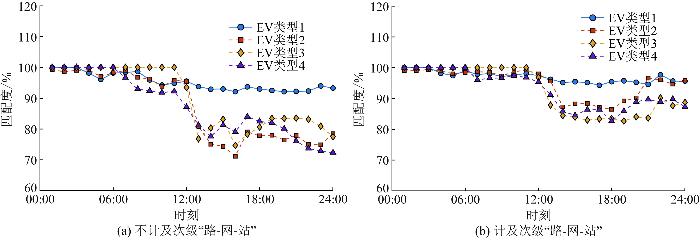
图D3给出了计及次级“路-网-站”前后各类型EV用户需求匹配度的变化。如图D3(a)所示,在高峰充电时段15:30—19:00,EV类型3、4的需求匹配度已接近70%。相比之下,计及次级“路-网-站”因素后,所有类型EV的需求匹配度均达到了80%以上。表D1所列出的数据显示,4种类型EV平均充电需求匹配度均得到明显提升。其中,EV类型2提升最多,共计提升了7.98%。此外,4类EV平均匹配度提升也达到了4.62%。
图D3 各类型EV用户充电需求匹配度Fig.D3 Matching degree of charging preferences among various types of EV drivers |
表D1 四种用户的平均充电需求匹配度Table D1 Average charging time of four type of EV in two scenarios |
| EV类型 | 平均充电需求匹配度/% | EV类型 | 平均充电需求匹配度/% | |||
|---|---|---|---|---|---|---|
| 不计及次级“路-网-站” | 计及次级“路-网-站” | 不计及次级“路-网-站” | 计及次级“路-网-站” | |||
| 1 | 95.22 | 96.97 | 3 | 89.97 | 92.49 | |
| 2 | 86.99 | 94.97 | 4 | 87.33 | 92.76 | |
| [1] |
IEA. Global EV outlook 2025 [EB/OL]. (2025-05-14)[2025-05-26]. https://www.iea.org/reports/global-ev-outlook-2025.
|
| [2] |
杨祺铭, 季陈林, 刘友波, 等. 多条公交线路的光储充电站日内滚动优化策略[J]. 智慧电力, 2020, 48(8): 44-50, 90.
|
| [3] |
中国充电联盟. 2025年一季度全国公共充电基础设施增长情况分析[R]. 北京: 中国充电联盟, 2025.
EVCIPA. Analysis of the growth of China’s public charging infrastructure in the first quarter of 2025[R]. Beijing: China Electric Vehicle Charging Infrastructure Promotion Alliance, 2025.
|
| [4] |
刘嘉彦, 李祖坤, 李畅, 等. 电动汽车与电力—交通耦合网互动: 综述与展望[J]. 电力科学与技术学报, 2024, 39(5): 12-24.
|
| [5] |
叶宇剑, 吴奕之, 胡健雄, 等. 城市电力-交通耦合系统的联合推演与协同优化: 研究综述、挑战与展望[J]. 中国电机工程学报, 2025, 45(11): 4144-4162.
|
| [6] |
杨祺铭, 李更丰, 别朝红, 等. 台风灾害下基于V2G的城市配电网弹性提升策略[J]. 电力系统自动化, 2022, 46(12): 130-139.
|
| [7] |
杨康, 石璐杉, 周航, 等. 含电动汽车集群的微电网多时间尺度优化调度[J]. 分布式能源, 2024, 9(3): 21-30.
电动汽车放电时可作为电网的一种分布式储能装置,参与缓解高比例新能源接入微电网的供电压力。基于多时间尺度下分时电价的特点,提出一种考虑电动汽车集群的微电网多时间尺度优化调度方法。在日前调度阶段,基于分时电价对微电网内部储能、可中断负荷、可转移负荷等设备出力进行优化调度;在日内优化调度阶段,将电动汽车集群纳入到微电网能量调度中来,通过分析各电动汽车集群的调度潜力来实现合理的充放电。为验证所提方案的有效性,选取不同的用电峰平谷时段分时电价,让电动汽车集群参与微电网能量调度,结果证明考虑电动汽车集群参与的微电网多时间尺度优化调度能充分利用电动汽车集群的储能资源,提升微电网调度运行的灵活性和经济性。
When discharging, electric vehicles can serve as distributed energy storage units of the power grid to alleviate the power supply pressure of microgrids with high proportions of new energy integration. Capitalizing on the characteristics of time-of-use tariffs across multi-time scales, this study proposes a multi-time scale optimization scheduling method for microgrids that takes into account clusters of electric vehicles. In day-ahead scheduling phase, the equipment output such as internal energy storage, interruptible loads and transferable loads in the microgrid is optimized based on time of use tariffs; During intra-day optimization scheduling phase, electric vehicle clusters will be included in the energy scheduling of microgrids, and reasonable charging and discharging can be achieved by analyzing the scheduling potential of each electric vehicle cluster. To verify the effectiveness of the proposed scheme, electric vehicle clusters are selected to participate in microgrid energy scheduling based on variable time of use tariffs during peak, flat, and valley periods. The results show that the multi-time scale optimization scheduling for microgrids considering the participation of electric vehicle clusters can make full use of the energy storage resources of electric vehicle clusters and improve the flexibility and economy of microgrid scheduling operation. |
| [8] |
郑颖颖, 缪新义, 王晖, 等. 支持时变需求响应激励价格的电动汽车优化充电策略[J]. 电力系统自动化, 2025, 49(9): 96-106.
|
| [9] |
李晓涵, 曹伟. 弹性充电需求下电动汽车调频激励机制及控制策略[J]. 中国电力, 2025, 58(4): 148-158.
|
| [10] |
刘丽军, 陈昌, 胡鑫, 等. 基于“车-路-站-网”信息耦合的电动汽车有序充电策略[J]. 高电压技术, 2024, 50(2): 693-703.
|
| [11] |
邢强, 陈中, 冷钊莹, 等. 基于实时交通信息的电动汽车路径规划和充电导航策略[J]. 中国电机工程学报, 2020, 40(2): 534-550.
|
| [12] |
王晗, 汤迪霏, 旷嘉庆, 等. 寒潮下基于智能导航的电动汽车充电网络韧性提升[J]. 电力工程技术, 2025, 44(6): 73-83.
|
| [13] |
江昌旭, 袁羽娟, 刘晨曦, 等. 用户综合满意度驱动的多智能体图强化学习电动汽车充电引导策略[J]. 电网技术, 2026, 50(5): 1985-2000.
|
| [14] |
刘洪, 阎峻, 葛少云, 等. 考虑多车交互影响的电动汽车与快充站动态响应[J]. 中国电机工程学报, 2020, 40(20): 6455-6467.
|
| [15] |
周健树, 向月, 张新, 等. 基于深度强化学习的高速公路服务区新能源充电站两阶段优化调控策略[J]. 中国电机工程学报, 2025, 45(11): 4130-4143.
|
| [16] |
申利民, 常晓彤, 李成宇, 等. 以目的地为导向的基于成本优化的电动汽车充电导航策略[J]. 计算机应用研究, 2025, 42(3): 863-869.
|
| [17] |
黄博, 胡博, 谢开贵, 等. 计及交通事故影响的电动汽车路径规划和充电导航策略[J]. 电力系统保护与控制, 2024, 52(19): 47-59.
|
| [18] |
陈立兴, 黄学良. 高速公路充电站电动汽车有序充电策略[J]. 电力自动化设备, 2019, 39(1): 112-117, 126.
|
| [19] |
徐鼎, 杨祺铭, 吴明明, 等. 基于安全深度强化学习的电力-交通耦合网络韧性提升策略[J]. 电力建设, 2026, 47(3): 24-38.
|
| [20] |
刘祺, 王承民, 谢宁, 等. 新型配电系统中考虑电动汽车差异化行为特性的充换电站规划方法[J]. 智慧电力, 2024, 52(9): 18-24, 64.
|
| [21] |
杨祺铭, 邬嘉雨, 李更丰, 等. 基于多类型虚拟电厂协同及交易结算的配电网弹性提升策略[J]. 智慧电力, 2025, 53(10): 26-35.
|
| [22] |
钱康, 李东森, 王佐君, 等. 考虑用户多样化需求的电动汽车集群调节能力评估研究[J]. 智慧电力, 2024, 52(11): 81-88.
|
| [23] |
周政, 杨祺铭, 卞艺衡, 等. “车-商-网”模式下面向配网弹性提升的分布式车网协同应急供电策略[J]. 高电压技术, 2026, 52(4): 1724-1737.
|
| [24] |
田万利, 吴忠广, 李娟, 等. 基于动态风险饱和度的高速公路交通安全分析[J]. 交通信息与安全, 2021, 39(5): 12-18, 42.
|
| [25] |
刘洪波, 刘珅诚, 盖雪扬, 等. 高比例新能源接入的主动配电网规划综述[J]. 发电技术, 2024, 45(1): 151-161.
新能源以分布式电源的形式接入配电网,给系统带来了不可控性、随机性和波动性问题。借助现代电力电子、信息通信及自动控制等技术,灵活可控的主动配电网成为发展趋势,其中主动配电网规划是近年来研究的热点之一。综合国内外在这一领域的研究成果,对主动配电网规划相关研究内容及其方法进行总结、分析及展望。对主动配电网基本结构进行了描述,介绍了配电网组成元素的特点;根据其控制变量的不同,对主动配电网规划模型进行了归类,总结了模型中的优化目标;针对常用模型求解算法及其优缺点进行分析、总结;通过对关键性问题的讨论,分析了未来主动配电网的发展趋势。
The new energy is connected to the distribution network in the form of distributed generation, which brings uncontrollability, randomness and volatility to the system. With the help of modern power electronics, information and communication and automatic control technologies, the active distribution network with flexibility and controllability has become a development trend. The active distribution network planning is one of the major research fields in recent years. Based on the research results in this field at home and abroad, the research contents and methods of active distribution network planning were summarized, analyzed and prospected. The basic structure of the active distribution network was described, and the characteristics of the components of the distribution network were introduced. According to the different control variables, the planning models of active distribution network were classified, the optimization objectives in the model were summarized. The commonly used model solving algorithms and their advantages and disadvantages were analyzed and summarized. Through the discussion of key issues, the development trend of active distribution network in the future was analyzed. |
| [26] |
刘悦. 保阜高速公路阜平西服务区电动汽车充电站工程设计[D]. 北京: 华北电力大学, 2018.
|
| [27] |
李鹏, 刘嘉彦, 李佳蔚, 等. 考虑光伏与电动汽车充电站协同的配电网电压控制方法[J]. 电力科学与技术学报, 2024, 39(6): 121-130.
|
| [28] |
江昌旭, 卢玥君, 袁羽娟, 等. 考虑里程焦虑的高速公路充电站及配电网扩展规划[J]. 电网技术, 2025, 49(9): 3881-3890.
|
| [29] |
谢宇峥, 章德, 杨祺铭, 等. 基于移动储能和电动汽车V2G的弹性配电网经济性灾后恢复决策方法[J]. 电工电能新技术, 2024, 43(7): 91-101.
近年来,为应对频发的极端事件,配电网弹性提升技术迅猛发展。在实际应用中,技术方案经济成本过高成为制约其应用落地的重要因素。针对上述问题,本文提出了一个融合移动储能与电动汽车并网(V2G)技术的配电网弹性提升方案,其具体目标为优化灾后供电恢复过程中的经济成本,同时确保恢复效能。在灾害初期,通过建立预先的电动汽车调度模型来获取电动汽车的分布状况以及各个V2G站点的最大供电能力。接着,基于实际的道路网络规划和电力负荷数据,决定临时的移动储能(MESS)仓库的安置地点。在灾害后期,将恢复过程中的综合经济成本作为优化目标,通过调整V2G站点的输出和MESS的调度策略来进行优化决策。对所提方法运用多组算例进行了验证,仿真结果表明,所提协同恢复方案在降低系统灾后失电量的同时能够有效改善弹性策略的经济性。
In recent years, the distribution network resilience enhancement technology developed in response to extreme events has developed rapidly. However, in practical applications, the high economic cost of technical solutions is one of the important factors restricting its implementation. Based on the above problems, this paper proposes an economic post-disaster restoration decision-making method for resilient distribution network with MESS and electric vehicle V2G, which reduces the economic cost of restoration while ensuring the restoration effect. In the pre-disaster stage, a pre-disaster electric vehicle scheduling model is established to obtain the distribution of electric vehicles and the maximum output of each V2G station. According to the actual line layout and load information, the MESS temporary warehouse deployment location is determined. In the post-disaster stage, the comprehensive economic cost of post-disaster restoration is taken as the objective function to optimize the V2G station output and MESS scheduling in the restoration process. The proposed method is verified by multiple sets of examples. The simulation results show that the proposed collaborative restoration scheme can effectively improve the economy of the resilient strategy while reducing the post-disaster power loss of the system.
|
| [30] |
崔景淏, 张怡, 张执超, 等. 路径规划下考虑电池损耗的纯电重卡集群充电负荷时空分布预测[J]. 电力建设, 2025, 46(6): 192-204.
|
| [31] |
谢宇峥, 章德, 杨祺铭, 等. 台风灾害下考虑修复不确定性和V2G的弹性城市电网动态供电恢复方法[J]. 电网与清洁能源, 2024, 40(6): 107-114.
|
| [32] |
|
| [33] |
高德地图. 中国主要城市交通分析报告[EB/OL].[2025-04-26]. https://report.amap.com/detail.dospm=379ed1f2.12a16d85.0.0.88bb3c47q07VxM&city=320200.
|
利益冲突声明(Conflict of Interests) 所有作者声明不存在利益冲突。
作者贡献声明(Authors' Contributions) 季陈林进行了研究设计,建立模型并进行数据分析,提出本文的核心方法,设计论文框架,负责论文写作与修订;杨祺铭参与模型建立、数据分析、撰写论文;刘友波参与研究方案可行性调查分析;邢强参与研究思路设计、数据收集、图谱绘制;汤迪霏参与论文修订、审核;刘达夫参与论文修订、审核。所有作者均阅读并同意了论文终稿内容。
/
| 〈 |
|
〉 |