Identification Method for Minimum Voltage Stability Margin Among Multiple Solutions Considering Component Limiting Characteristics

SUN Wenhao, WANG Lei, LIU Qi, LIU Hongyan

Electric Power Construction ›› 2026, Vol. 47 ›› Issue (10) : 75-84.

PDF(1437 KB)
PDF(1437 KB)
Electric Power Construction ›› 2026, Vol. 47 ›› Issue (10) : 75-84. DOI: 10.12204/j.issn.1000-7229.2026.10.006
Dispatch & Operation

Identification Method for Minimum Voltage Stability Margin Among Multiple Solutions Considering Component Limiting Characteristics

Author information +
History +

Abstract

[Objective] To address the problems of multiple power flow solutions and multiple voltage stability critical points caused by component limiting characteristics, a staged identification method for identifying the minimum voltage stability margin is proposed. [Methods] The minimum voltage stability margin is identified based on the correlation between the voltage stability margin and the violation step length. First, a complementary constraint method is employed to filter out infeasible solutions. Then, a sensitivity analysis is performed to predict the earliest violation behavior and generate a summary list. Finally, the critical solutions in the list are computed in detail to obtain the minimum load margin. [Results] The case study results show that the proposed method has a prediction error of about 2.11% for the first limit violation, and its computation time is reduced by nearly 40% compared with solving the continuation power flow case by case, achieving a balance between identification accuracy and computational efficiency. [Conclusions] The proposed method significantly improves computational efficiency while ensuring solution accuracy, providing a theoretical and model reference for research on multiple solution problems in voltage stability.

Key words

voltage stability critical point / limiting characteristics / multiple solutions / sensitivity analysis

Cite this article

Download Citations
SUN Wenhao , WANG Lei , LIU Qi , et al. Identification Method for Minimum Voltage Stability Margin Among Multiple Solutions Considering Component Limiting Characteristics[J]. Electric Power Construction. 2026, 47(10): 75-84 https://doi.org/10.12204/j.issn.1000-7229.2026.10.006

附录A

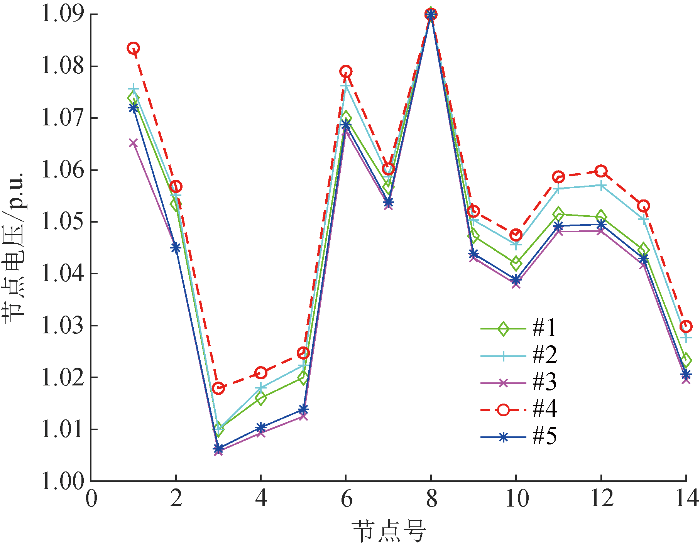
图A1 电压幅值计算结果对比

Fig.A1 Voltage magnitude calculation comparison

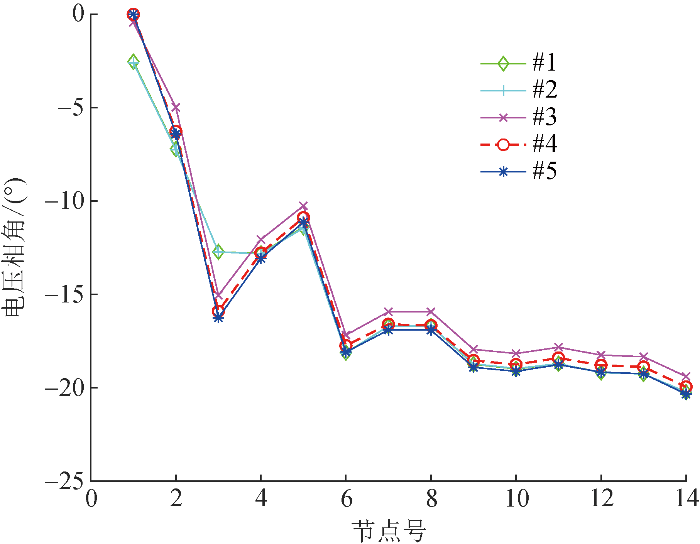
图A2 电压相角计算结果对比

Fig.A2 Voltage phase angle calculation comparison

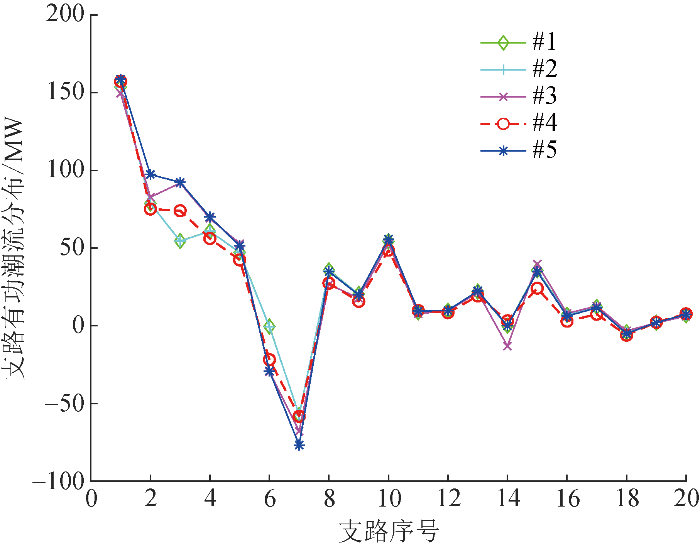
图A3 支路有功潮流计算结果对比

Fig.A3 Branch active power flow calculation comparison

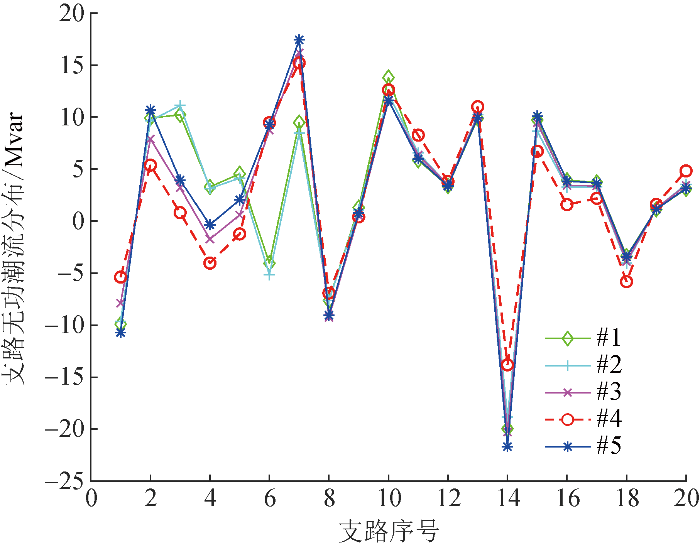
图A4 支路无功潮流计算结果对比

Fig.A4 Branch reactive power flow calculation comparison

References

[1]
孙大雁, 耿建, 杨胜春, 等. 新型电力系统环境下煤电与新能源等多元资源协调优化运行及其挑战[J]. 电网技术, 2024, 48(8): 3105-3113.
Sun Dayan, Geng Jian, Yang Shengchun, et al. Challenges of coordinated and optimized operation of coal power and new energy and other diversified resources in new power system[J]. Power System Technology, 2024, 48(8): 3105-3113.
[2]
孙华东, 徐式蕴, 许涛, 等. 电力系统安全稳定性的定义与分类探析[J]. 中国电机工程学报, 2022, 42(21): 7796-7809.
Sun Huadong, Xu Shiyun, Xu Tao, et al. Research on definition and classification of power system security and stability[J]. Proceedings of the CSEE, 2022, 42(21): 7796-7809.
[3]
齐金山, 姚良忠, 廖思阳, 等. 高比例新能源电力系统静态电压稳定裕度在线概率评估[J]. 电力系统保护与控制, 2023, 51(5): 47-57.
Qi Jinshan, Yao Liangzhong, Liao Siyang, et al. Online probabilistic assessment of static voltage stability margin for power systems with a high proportion of renewable energy[J]. Power System Protection and Control, 2023, 51(5): 47-57.
[4]
鲍海波, 郭小璇. 考虑新能源发电不确定性的静态电压稳定故障筛选与排序方法[J]. 电力自动化设备, 2019, 39(7): 57-63.
Bao Haibo, Guo Xiaoxuan. Fault screening and ranking method of static voltage stability considering uncertainty of renewable energy power generation[J]. Electric Power Automation Equipment, 2019, 39(7): 57-63.
[5]
陈昌, 姜彤, 万凯遥, 等. 直接计算静态电压稳定裕度的改进崩溃点法[J]. 电力自动化设备, 2020, 40(11): 150-155.
Chen Chang, Jiang Tong, Wan Kaiyao, et al. Improved point of collapse method for direct calculation of static voltage stability margin[J]. Electric Power Automation Equipment, 2020, 40(11): 150-155.
[6]
黎晓, 刘崇茹, 蔡晖, 等. 电力系统静态电压稳定临界点的快速计算方法[J]. 华北电力大学学报(自然科学版), 2022, 49(3): 44-54.
Li Xiao, Liu Chongru, Cai Hui, et al. Fast calculation method for critical point of static voltage stability in power system[J]. Journal of North China Electric Power University, 2022, 49(3): 44-54.
[7]
Guo D L, Wang L, Jiao T C, et al. Day-ahead voltage-stability-constrained network topology optimization with uncertainties[J]. Journal of Modern Power Systems and Clean Energy, 2024, 12(3): 730-741.
[8]
王妍, 高山. 基于改进Chord法的电力系统连续潮流计算新方法[J]. 电力系统保护与控制, 2022, 50(4): 112-119.
Wang Yan, Gao Shan. A new method of power system continuous flow calculation based on an improved Chord method[J]. Power System Protection and Control, 2022, 50(4): 112-119.
[9]
赵晋泉, 汤奕, 党杰, 等. 计及高比例新能源多种控制方式及运行约束的连续潮流[J]. 电力系统自动化, 2024, 48(16): 123-131.
Zhao Jinquan, Tang Yi, Dang Jie, et al. Continuous power flow considering multiple control modes and operational constraints of high proportion of renewable energy[J]. Automation of Electric Power Systems, 2024, 48(16): 123-131.
[10]
方斯顿, 程浩忠, 徐国栋, 等. 基于混合光线反射优化算法的最近电压稳定临界点求取方法[J]. 电力自动化设备, 2016, 36(8): 58-62, 75.
Fang Sidun, Cheng Haozhong, Xu Guodong, et al. Closest voltage-stability critical-point calculation based on SOIO algorithm[J]. Electric Power Automation Equipment, 2016, 36(8): 58-62, 75.
[11]
赵真, 袁旭峰, 艾小清, 等. 柔性互联配电网概率潮流算法研究[J]. 电测与仪表, 2023, 60(12): 90-95.
Zhao Zhen, Yuan Xufeng, Ai Xiaoqing, et al. Research on probabilistic load flow algorithm for flexible interconnected distribution network[J]. Electrical Measurement & Instrumentation, 2023, 60(12): 90-95.
[12]
马玉涛, 刘青, 李龙威, 等. 基于随机降阶与随机响应面法的电网概率潮流计算[J]. 分布式能源, 2025, 10(2): 90-97.
Abstract
源荷不确定性是新型电力系统的典型特点之一,因此有必要对考虑源荷变化的电网概率潮流进行计算。针对随机响应面法(stochastic response surface method,SRSM)在构建多项式混沌展开式时通过随机抽样生成样本的盲目性,采用随机降阶法(stochastic reduced order method,SROM)选取重要样本以提高计算结果的准确性。将光照强度、风速参数和负荷作为随机输入变量,建立源荷概率模型并对其进行相关性处理,采用SROM选取三维输入变量的重要样本生成概率潮流的多项式混沌展开式;提出基于SROM-SRSM的电力系统概率潮流计算方法并给出详细计算流程;以改进的IEEE 33节点系统为算例,比较了不同多项式阶数下的模拟时间和精度,采用3阶多项式混沌展开式作为概率潮流计算的基础,比较了不同计算方法下的概率潮流计算结果,得到了潮流状态变量的概率分布。 结果表明:相对于传统的蒙特卡罗方法,所提的SROM-SRSM方法减少了计算耗时,采用随机降阶法优选样本提高了概率潮流计算结果的准确性。
Ma Yutao, Liu Qing, Li Longwei, et al. Probabilistic power flow calculation based on stochastic reduced order method and stochastic response surface method[J]. Distributed Energy, 2025, 10(2): 90-97.

Source-load uncertainty is one of the typical characteristics of new power systems, so it is necessary to calculate the probabilistic tidal currents of power grids considering source-load variations. Aiming at the blindness of stochastic response surface method (SRSM) in constructing polynomial chaotic expansion by random sampling to generate samples, this paper adopts stochastic reduced order method (SROM) to select important samples in order to improve the accuracy of calculation results. The light intensity, wind speed parameter and load are taken as random input variables, the source-load probability model is established and its correlation is processed, and the polynomial chaotic expansion of probabilistic tidal current is generated by using SROM to select the important samples of the three-dimensional input variables; the probabilistic tidal current computation method of the electric power system based on SROM-SRSM is proposed and the detailed computation process is given; the improved IEEE 33-node system is used as an example to the simulation time and accuracy under different polynomial orders are compared; the 3rd order polynomial chaotic expansion is used as the basis of probabilistic tidal current calculation; the results of probabilistic tidal current calculation under different calculation methods are compared and the probability distribution of tidal current state variables is obtained. The results show that compared with the traditional Monte Carlo method, the SROM-SRSM proposed in this paper reduces the computation time, and the accuracy of the probabilistic tidal current calculation results is improved by adopting the stochastic descending order method to optimize the samples.

[13]
曹宏宇, 梁言贺, 刘惠颖, 等. 考虑电源与负荷间存在非正定相关性的概率潮流计算方法研究[J]. 电测与仪表, 2024, 61(7): 109-115.
Cao Hongyu, Liang Yanhe, Liu Huiying, et al. Research on probabilistic power flow calculation method considering non-positive definite correlation between power source and load[J]. Electrical Measurement & Instrumentation, 2024, 61(7): 109-115.
[14]
曹宏宇, 梁言贺, 刘惠颖, 等. 考虑风-光-储不确定性的新型电力系统概率潮流计算[J]. 电测与仪表, 2024, 61(6): 87-93.
Cao Hongyu, Liang Yanhe, Liu Huiying, et al. Probabilistic power flow calculation of novel power system considering uncertainty of wind-light-storage[J]. Electrical Measurement & Instrumentation, 2024, 61(6): 87-93.
[15]
蔡广林, 张勇军, 蔡泽祥, 等. 光滑化非线性互补约束的节点类型转换模型[J]. 中国电机工程学报, 2008, 28(31): 29-34.
Cai Guanglin, Zhang Yongjun, Cai Zexiang, et al. Bus type switch model based on smooth nonlinear complementarity constraints[J]. Proceedings of the CSEE, 2008, 28(31): 29-34.
[16]
朱一昕, 吴浩宇, 张志伟, 等. 含能量路由器的交直流混合配电网潮流计算[J]. 电力工程技术, 2024, 43(1): 136-145.
Zhu Yixin, Wu Haoyu, Zhang Zhiwei, et al. Power flow calculation of AC-DC hybrid distribution network with energy routers[J]. Electric Power Engineering Technology, 2024, 43(1): 136-145.
[17]
李智欢, 韩云飞, 苏寅生, 等. 基于节点类型转换的潮流收敛性调整方法[J]. 电力系统自动化, 2015, 39(7): 188-193.
Li Zhihuan, Han Yunfei, Su Yinsheng, et al. A convergence adjustment method of power flow based on node type switching[J]. Automation of Electric Power Systems, 2015, 39(7): 188-193.
[18]
王艳杰, 衣涛. PQ-PV节点类型相互转换过程中的静态电压失稳分析[J]. 电力系统及其自动化学报, 2017, 29(4): 101-103.
Wang Yanjie, Yi Tao. Static voltage instability analysis of PQ-PV node type interconversion[J]. Proceedings of the CSU-EPSA, 2017, 29(4): 101-103.
[19]
王海军, 邢东峰, 朱宏超, 等. 基于PSD-BPA的无功潮流收敛性二阶段自动调整方法[J]. 广东电力, 2024, 37(11): 72-82.
Wang Haijun, Xing Dongfeng, Zhu Hongchao, et al. Two-stage automatic adjustment method for reactive power flow convergence based on PSD-BPA[J]. Guangdong Electric Power, 2024, 37(11): 72-82.
[20]
徐鹏, 郭新元, 赵伟, 等. 功率与频率耦合下100%新能源电力系统的潮流分析模型[J]. 智慧电力, 2024, 52(12): 73-79, 87.
Xu Peng, Guo Xinyuan, Zhao Wei, et al. Power flow analysis model of power system with 100% renewable energy under power-frequency coupling[J]. Smart Power, 2024, 52(12): 73-79, 87.
[21]
徐政. 新型电力系统背景下三大计算的适应性分析[J]. 高电压技术, 2025, 51(8): 3918-3926.
Xu Zheng. Analysis of the adaptability of three classic computations under the new energy power system context[J]. High Voltage Engineering, 2025, 51(8): 3918-3926.
[22]
赵晋泉, 范晓龙, 高宗和, 等. 含分布式电源的三相不平衡配电网连续潮流计算[J]. 电力系统自动化, 2015, 39(9): 48-53.
Zhao Jinquan, Fan Xiaolong, Gao Zonghe, et al. Continuation power flow calculation for unbalanced three-phase distribution networks with distributed generators[J]. Automation of Electric Power Systems, 2015, 39(9): 48-53.
[23]
杨杉, 喻希, 罗朝旭, 等. 含换流器型分布式电源配电网的不对称短路电流计算方法[J]. 电力系统保护与控制, 2024, 52(10): 44-53.
Yang Shan, Yu Xi, Luo Zhaoxu, et al. Asymmetric short-circuit current calculation of a distribution network with inverter-based distributed generation[J]. Power System Protection and Control, 2024, 52(10): 44-53.
[24]
石飞, 赵晋泉, 王毅. 计及发电机无功约束的最优乘子潮流计算方法比较[J]. 电力系统保护与控制, 2009, 37(2): 6-10.
Shi Fei, Zhao Jinquan, Wang Yi. A comparison of Newton-raphson optimal multipliers load flow methods considering generator reactive power limitation[J]. Power System Protection and Control, 2009, 37(2): 6-10.
[25]
鲍海波, 韦化. 考虑发电机运行极限的电压稳定临界点互补模型与算法[J]. 电力系统自动化, 2012, 36(22): 12-18.
Bao Haibo, Wei Hua. A complementary model and algorithm for critical points of static voltage stability considering generator capability limits[J]. Automation of Electric Power Systems, 2012, 36(22): 12-18.
[26]
林济铿, 石伟钊, 武乃虎, 等. 计及离散变量基于互补约束全光滑牛顿法的无功优化[J]. 中国电机工程学报, 2012, 32(1): 93-100.
Lin Jikeng, Shi Weizhao, Wu Naihu, et al. Reactive power optimization with discrete variables based on complementarity constraints smooth Newton method[J]. Proceedings of the CSEE, 2012, 32(1): 93-100.
[27]
赵晋泉, 江晓东, 张伯明. 潮流计算中PV-PQ节点转换逻辑的研究[J]. 中国电机工程学报, 2005, 25(1): 54-59.
Zhao Jinquan, Jiang Xiaodong, Zhang Boming. Study on PV-PQ bus type switching logic in power flow computation[J]. Proceedings of the CSEE, 2005, 25(1): 54-59.
[28]
颜廷鑫, 刘光晔, 谢冬冬. 计及发电机运行极限的电压稳定临界点计算[J]. 电力系统及其自动化学报, 2017, 29(8): 119-125.
Yan Tingxin, Liu Guangye, Xie Dongdong. Calculation of voltage stability critical point considering generator capability limits[J]. Proceedings of the CSU-EPSA, 2017, 29(8): 119-125.
[29]
蔡广林, 张勇军, 任震, 等. 采用非线性互补约束模型确定静态电压稳定临界点[J]. 中国电机工程学报, 2008, 28(16): 8-14.
Cai Guanglin, Zhang Yongjun, Ren Zhen, et al. Static voltage stability critical point assessment applying nonlinear complementarity constraints model[J]. Proceedings of the CSEE, 2008, 28(16): 8-14.
[30]
Bakhtvar M, Keane A. Allocation of wind capacity subject to long term voltage stability constraints[J]. IEEE Transactions on Power Systems, 2016, 31(3): 2404-2414.
[31]
Neves L S, Alberto L F C, Chiang H D. Smooth power flow model for unified voltage stability assessment: theory and computation[J]. IEEE Transactions on Power Systems, 2022, 37(6): 4579-4589.
[32]
Song Y, Liu T, Hou Y H. Voltage stability constrained optimal power flow considering PV-PQ bus type switching: formulation and convexification[J]. IEEE Transactions on Power Systems, 2024, 39(2): 3336-3348.
[33]
Zeng L, Chiang H D. Mulitple power flow solutions due to PV-PQ switching and their properties[C]// 2022 IEEE Power & Energy Society General Meeting (PESGM). IEEE, 2022: 1-5.
[34]
Parvania M, Scaglione A. Unit commitment with continuous-time generation and ramping trajectory models[J]. IEEE Transactions on Power Systems, 2016, 31(4): 3169-3178.
[35]
刘水霞. 互补约束优化问题若干算法研究[D]. 呼和浩特: 内蒙古大学, 2009.
Liu Shuixia. Study on several algorithms for mathematical programs with complementarity constraints[D]. Hohhot: Inner Mongolia University, 2009.
[36]
Zimmerman R D, Murillo-Sánchez C E, Thomas R J. MATPOWER: steady-state operations, planning, and analysis tools for power systems research and education[J]. IEEE Transactions on Power Systems, 2011, 26(1): 12-19.

Footnotes

利益冲突声明(Conflict of Interests): 所有作者声明不存在利益冲突。

作者贡献声明(Authors' Contributions): 孙文浩完成实验、数据分析及论文写作;王蕾进行整体研究设计和论文修改;刘奇、刘红岩参与论文修订。所有作者均阅读并同意了论文终稿内容。

Funding

National Natural Science Foundation of China(52377109)
Hainan Provincial Natural Science Foundation of China(525QY910)
PDF(1437 KB)

Accesses

Citation

Detail

Recommended

/

〈 〉