Distributionally Robust Optimization-Based Dynamic Pricing Model and Solution Method for Multiple Virtual Power Plants in a Stackelberg Game

CHEN Qu, YANG Ping, CHEN Nianhao, LIU Genrao, YAN Lu

Electric Power Construction ›› 2026, Vol. 47 ›› Issue (10) : 166-180.

PDF(2522 KB)
PDF(2522 KB)
Electric Power Construction ›› 2026, Vol. 47 ›› Issue (10) : 166-180. DOI: 10.12204/j.issn.1000-7229.2026.10.013
Power Economics

Distributionally Robust Optimization-Based Dynamic Pricing Model and Solution Method for Multiple Virtual Power Plants in a Stackelberg Game

Author information +
History +

Abstract

[Objective] To address the Stackelberg game between multiple virtual power plants (VPP) and a distribution system operator (DSO), where existing dynamic pricing models fail to adequately account for the impact of renewable energy output uncertainty on game strategies, and conventional solution methods suffer from poor performance in high-dimensional decision spaces, this paper proposes a dynamic pricing model and solution method based on distributionally robust optimization (DRO) within a Stackelberg game framework. [Methods] A Stackelberg game dynamic pricing model is formulated with the DSO as the leader and multiple VPPs as followers. In the VPP optimization subproblem, a distributionally robust chance constraint is introduced to capture wind power output uncertainty. An ambiguity set is constructed using only the first and second moments of wind power, and the chance constraint is transformed into a deterministic equivalent via the Cantelli inequality. Moreover, a neural network-enhanced regional particle swarm optimization (NN‑RPSO) algorithm is proposed, which constructs a predictive model of VPP behavior to replace frequent calls to the lower‑level optimization, and incorporates a regional partitioning strategy to enable efficient search. [Results] The results show that decision‑makers can trade off operational risk against cost by adjusting the risk budget parameters. Compared with the regional particle swarm optimization (RPSO) algorithm, the proposed NN‑RPSO increases the DSO’s revenue by 47.2% while reducing the number of lower‑level model calls by approximately 67.4%. [Conclusions] The proposed DRO model provides decision‑makers with a flexible means to handle uncertainty, and the proposed algorithm markedly enhances solution quality, offering an effective approach for the multi‑agent Stackelberg game problem.

Key words

multiple virtual power plants / distribution system operator / Stackelberg game / distributionally robust optimization / dynamic pricing / neural network-enhanced regional particle swarm optimization(NN-RPSO)

Cite this article

Download Citations
CHEN Qu , YANG Ping , CHEN Nianhao , et al . Distributionally Robust Optimization-Based Dynamic Pricing Model and Solution Method for Multiple Virtual Power Plants in a Stackelberg Game[J]. Electric Power Construction. 2026, 47(10): 166-180 https://doi.org/10.12204/j.issn.1000-7229.2026.10.013

附录A

A.1 均衡解存在证明

当满足以下条件时,Stackelberg博弈均衡解存在:

1)DSO和VPP的收益函数为关于其策略集的连续函数;

2)VPP的收益函数为关于其策略集的拟凸函数。

存在性证明:

对于1)显然成立;

对于2),VPP的收益函数可以由式(6)确定,其中,CVPP为关于 ${\mathit{P}}_{\mathit{t}}^{\mathrm{V}\mathrm{P}\mathrm{P},\mathrm{b}}\mathrm{、}$ ${\mathit{P}}_{\mathit{t}}^{\mathrm{V}\mathrm{P}\mathrm{P},\mathrm{s}}$的线性函数;CVPP为关于 ${\mathit{P}}_{\mathit{j},\mathit{t}}^{\mathrm{M}\mathrm{T}}$的凸函数;CVPP为关于 ${\mathit{P}}_{\mathit{j},\mathit{t}}^{\mathrm{c}\mathrm{h}}\mathrm{、}{\mathit{P}}_{\mathit{j},\mathit{t}}^{\mathrm{d}\mathrm{c}\mathrm{h}}$的凸函数;CVPP为关于 ${\mathit{P}}_{\mathit{j},\mathit{t}}^{\mathrm{I}\mathrm{L}}$的线性函数;CVPP为关于 ${\mathit{R}}_{\mathit{j},\mathit{t}}^{\mathrm{u}\mathrm{p}}\mathrm{、}{\mathit{R}}_{\mathit{j},\mathit{t}}^{\mathrm{d}\mathrm{n}}$的线性函数。因此,从整体来看,VPP的收益函数为关于其策略集的拟凸函数。

A.2 均衡解唯一证明

当满足以下条件时,Stackelberg博弈均衡解唯一:

1)当DSO给定策略,VPP存在唯一最优策略;

2)当VPP给定策略,DSO存在唯一最优策略。

唯一性证明:

对于1),对VPP的收益函数关于其策略集求二阶偏导:

$\frac{\partial^{2} C^{\mathrm{VPP}}}{\left(\partial P_{t}^{\mathrm{VPP}, \mathrm{~b}}\right)^{2}}=0$
$\frac{\partial^{2} C^{\mathrm{VPP}}}{\left(\partial P_{t}^{\mathrm{VPP}, \mathrm{~s}}\right)^{2}}=0$
$\frac{\partial^{2} C^{\mathrm{VPP}}}{\left(\partial P_{j, t}^{\mathrm{MT}}\right)^{2}}=2 a_{j}$
$\frac{\partial^{2} C^{\mathrm{VPP}}}{\left(\partial P_{j, t}^{\mathrm{ch}}\right)^{2}}=2 \lambda_{j}^{\mathrm{BESS}}$
$\frac{\partial^{2} C^{\mathrm{VPP}}}{\left(\partial P_{j, t}^{\mathrm{dch}}\right)^{2}}=2 \lambda_{j}^{\mathrm{BESS}}$
$\frac{\partial^{2} C^{\mathrm{VPP}}}{\left(\partial P_{j, t}^{\mathrm{IL}}\right)^{2}}=0$
$\frac{\partial^{2} C^{\mathrm{VPP}}}{\left(\partial R_{j, t}^{\mathrm{up}}\right)^{2}}=0$
$\frac{\partial^{2} C^{\mathrm{VPP}}}{\left(\partial R_{j, t}^{\mathrm{dn}}\right)^{2}}=0$

由此可知,VPP的Hessian矩阵为半正定矩阵,因此当DSO给定策略后,VPP存在唯一最优策略。

对于2),对DSO的收益函数关于其策略集求二阶偏导:

$\frac{\partial^{2} C^{\mathrm{DSO}}}{\left(\partial \lambda_{t}^{\mathrm{D}, \mathrm{~b}}\right)^{2}}=0$
$\frac{\partial^{2} C^{\mathrm{DSO}}}{\left(\partial \lambda_{t}^{\mathrm{D}, \mathrm{~s}}\right)^{2}}=0$

DSO的收益函数关于其策略集的二阶偏导均为0,可知其收益函数为多元线性函数,因此,当VPP给定策略后,DSO存在唯一最优策略。

附录B

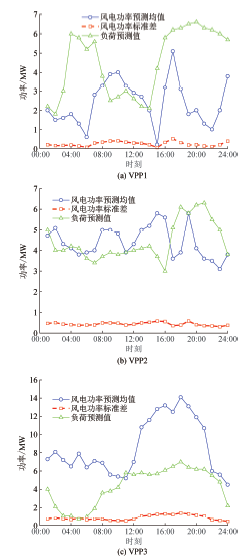
图B1 新能源及负荷预测出力情况

Fig. B1 Forecasted output of renewable energy and load

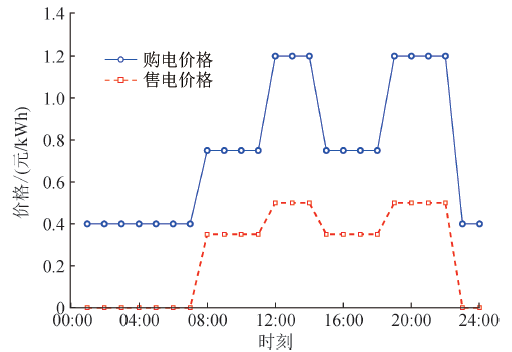
图B2 各时段购售价格区间

Fig. B2 Purchase and sale price intervals in each period

附录C

C.1 参数设置

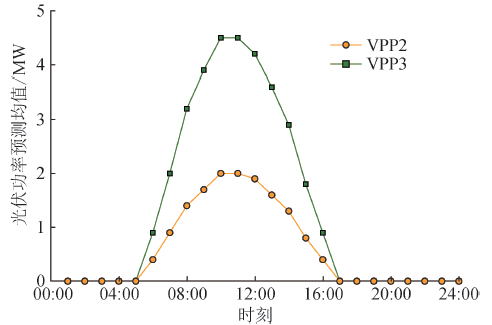
为验证本文方法在多源不确定性场景下的适用性,本附录在原算例基础上引入光伏出力不确定性。设VPP2和VPP3的光伏出力均值预测曲线如图C1所示,光伏出力标准差上限取风电标准差的80%。风电与光伏出力相互独立,新能源总出力的均值 ${\mathit{\mu }}_{\mathit{j},\mathit{t}}^{\mathrm{R}\mathrm{E}}={\mathit{\mu }}_{\mathit{j},\mathit{t}}^{\mathrm{w}\mathrm{i}\mathrm{n}\mathrm{d}}+{\mathit{\mu }}_{\mathit{j},\mathit{t}}^{\mathrm{P}\mathrm{V}}$,新能源出力方差上界 ${\stackrel{-}{\mathit{\sigma }}}_{\mathit{j},\mathit{t}}^{\mathrm{R}\mathrm{E}}=\sqrt{({\stackrel{-}{\mathit{\sigma }}}_{\mathit{j},\mathit{t}}^{\mathrm{w}\mathrm{i}\mathrm{n}\mathrm{d}}{)}^{2}+({\stackrel{-}{\mathit{\sigma }}}_{\mathit{j},\mathit{t}}^{\mathrm{P}\mathrm{V}}{)}^{2}}$,代入本文所构建的分布鲁棒优化模型即可。

图C1 VPP2和VPP3的光伏出力预测情况

Fig.C1 Forecasted PV output of VPP2 and VPP3

C.2 结果分析

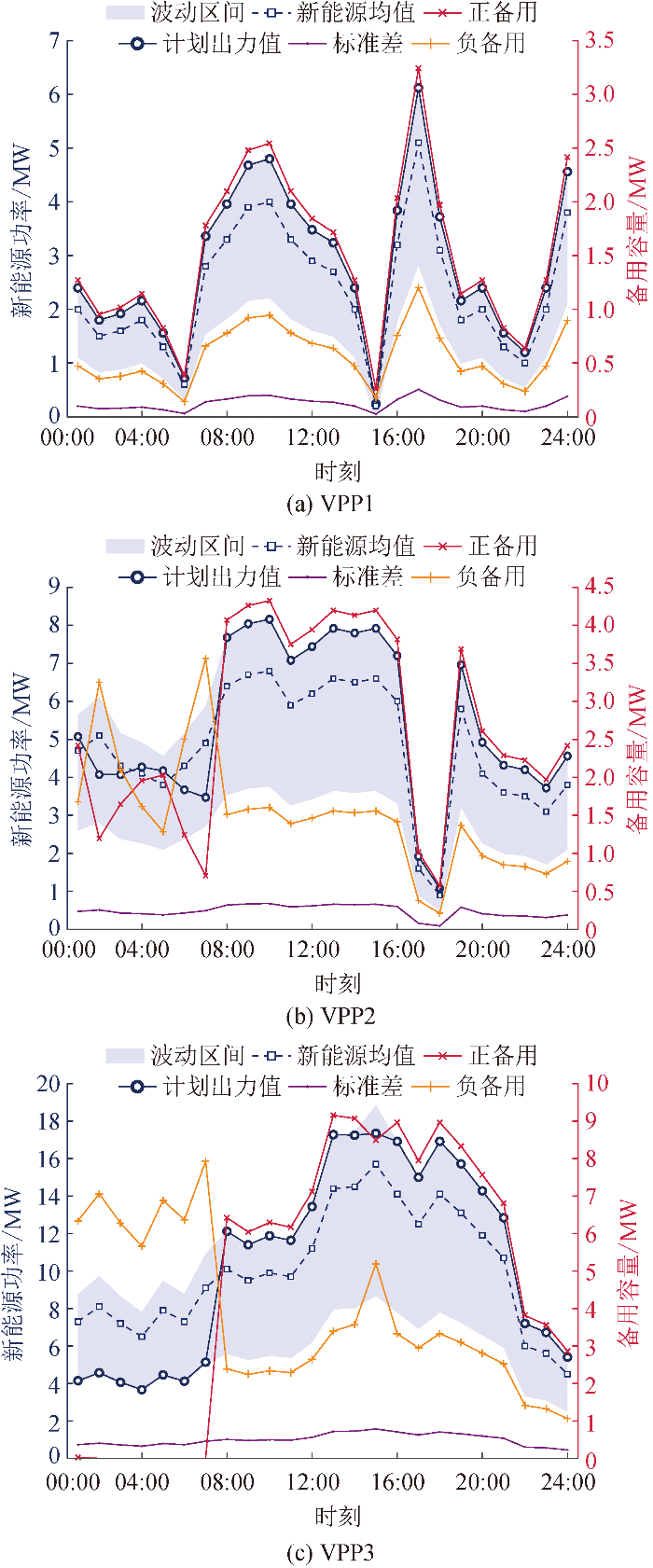
对多源不确定性模型进行分布鲁棒机会约束建模,并采用本文所提方法进行求解,得到的仿真结果如图C2所示。

图C2 VPP新能源出力及备用配置情况

Fig.C2 Renewable energy output and reserve allocation of VPP

从图C2可以看出,当新能源出力波动上界降低时,系统正负备用也会随之降低。当新能源计划出力大于出力均值时,即调度计划更激进,那么出现实际风电出力不足情况的概率就会增加,于是从图C2中体现出来的结果就是系统正备用大于系统负备用。反之亦然。上述结果同样可以表明本文所提的分布鲁棒优化模型在面对风电不确定性时,可以通过灵活调整备用容量来平衡电力供需,确保系统的可靠性与经济性。

不同风险预算下的VPP运行与备用成本见表C1。从表C1的仿真结果可以看出,随着风险预算参数从0.05增大至0.20,各VPP的运行成本和备用成本均呈现下降趋势,表明决策者可通过调节风险预算在运行风险与经济性之间进行灵活权衡。并且多源不确定性场景下备用成本略高于单风电场景,这是由于光伏出力的引入增加了总不确定性的方差,系统需要预留更多的备用容量以应对叠加后的出力波动。但两者随风险预算的变化趋势一致,验证了本文所提方法的可扩展性。

表C1 多源不确定性场景中不同风险预算下的VPP运行与备用成本

Table C1 VPP operation and reserve costs under different risk budgets in multi-source uncertainty scenario

风险预算 VPP 运行成本/元 备用成本/元
0.05 1 69 884 13 140
2 44 595 25 923
3 17 573 52 796
0.10 1 66 546 9255
2 36 493 18 337
3 -1210 37 872
0.15 1 65 851 7640
2 32 359 14 865
3 -5427 30 386
0.20 1 64 304 6610
2 31 504 12 800
3 -9067 26 183

综上,本附录验证了本文方法对风电-光伏多源不确定性场景的适用性。结果表明,本文所提分布鲁棒优化模型能够根据风光出力的波动特征,灵活调整正负备用容量以平衡电力供需,在保障系统可靠性的同时优化运行经济性。决策者可通过调节风险预算参数在运行风险与运行成本之间进行权衡,验证了该方法具有良好的可扩展性。

References

[1]
孙荣富, 王歌, 闵睿, 等. 面向新型电力系统的虚拟电厂交易机制设计[J/OL]. 电力系统自动化, 2026-01-23. https://link.cnki.net/urlid/32.1180.TP.20260122.1705.004.
Sun Rongfu, Wang Ge, Min Rui, et al. Trading mechanism design of virtual power plants for new power system[J/OL]. Automation of Electric Power Systems, 2026-01-23. https://link.cnki.net/urlid/32.1180.TP.20260122.1705.004.
[2]
高明, 曾平良, 冯永朝. 新型电力系统中的虚拟电厂研究综述[J]. 电力工程技术, 2025, 44(6): 143-154.
Gao Ming, Zeng Pingliang, Feng Yongchao. Review of virtual power plant in new power system[J]. Electric Power Engineering Technology, 2025, 44(6): 143-154.
[3]
罗祾, 陈甜甜, 华珉, 等. 考虑点对点交易的虚拟电厂联盟协同优化策略[J]. 浙江电力, 2025, 44(12): 55-66.
Luo Ling, Chen Tiantian, Hua Min, et al. A collaborative optimization strategy for virtual power plant alliance considering peer-to-peer trading[J]. Zhejiang Electric Power, 2025, 44(12): 55-66.
[4]
宋铎洋, 薛田良, 李艺瀑, 等. 考虑风光不确定性的虚拟电厂合作博弈调度及收益分配策略[J]. 电力工程技术, 2025, 44(1): 193-206.
Song Duoyang, Xue Tianliang, Li Yipu, et al. Cooperative game scheduling and revenue sharing strategy for virtual power plants considering scenery uncertainty[J]. Electric Power Engineering Technology, 2025, 44(1): 193-206.
[5]
余英, 王海云, 王维庆, 等. 虚拟电厂参与下含高渗透可再生能源系统的运行策略[J]. 电测与仪表, 2023, 60(1): 94-103.
Yu Ying, Wang Haiyun, Wang Weiqing, et al. Operation strategy of high permeability renewable energy with virtual power plant participation[J]. Electrical Measurement & Instrumentation, 2023, 60(1): 94-103.
[6]
Wang H, Jia Y W, Shi M G, et al. A mutually beneficial operation framework for virtual power plants and electric vehicle charging stations[J]. IEEE Transactions on Smart Grid, 2023, 14(6): 4634-4648.
[7]
陈永权, 方瑜. 多组合虚拟电厂中氢储能低碳经济配置与优化[J]. 电网与清洁能源, 2024, 40(3): 107-118.
Chen Yongquan, Fang Yu. Low carbon economic configuration and optimization of hydrogen storage in multi-portfolio virtual power plants[J]. Power System and Clean Energy, 2024, 40(3): 107-118.
[8]
吴亚雄, 申展, 吴科成. 考虑配电系统运营商和多主体博弈的配电网规划方法[J]. 高压电器, 2025, 61(12): 209-218.
Wu Yaxiong, Shen Zhan, Wu Kecheng. Distribution network planning method considering distribution system operators and multi-agent game[J]. High Voltage Apparatus, 2025, 61(12): 209-218.
[9]
陈耀威, 米阳, 马思源, 等. 绿证-碳交易市场下基于广义纳什博弈的多虚拟电厂点对点交易策略[J]. 浙江电力, 2025, 44(12): 43-54.
Chen Yaowei, Mi Yang, Ma Siyuan, et al. A peer-to-peer trading strategy for multiple virtual power plants based on generalized Nash game in green certificate-carbon trading markets[J]. Zhejiang Electric Power, 2025, 44(12): 43-54.
[10]
史林军, 燕志伟, 李杨, 等. 基于动态电价机制的配网运营商与用户储能商双层协调多目标优化策略[J]. 太阳能学报, 2024, 45(6): 75-85.
Shi Linjun, Yan Zhiwei, Li Yang, et al. Double-layer coordination multi-objective optimization strategy for distribution network operators and customer energy storage providers based on dynamic electricity price mechanism[J]. Acta Energiae Solaris Sinica, 2024, 45(6): 75-85.
[11]
檀勤良, 曾贾斌, 吕函谕, 等. 考虑源网荷储协同的配网侧分布式光伏市场交易策略优化[J]. 中国电力, 2025, 58(10): 39-49.
Tan Qinliang, Zeng Jiabin, Lü Hanyu, et al. Optimization of distribution-side distributed photovoltaic market trading strategies considering source-grid-load-storage coordination[J]. Electric Power, 2025, 58(10): 39-49.
[12]
舒征宇, 朱凯翔, 王灿, 等. 考虑碳交易的虚拟电厂日前电力市场竞价策略[J]. 电力工程技术, 2024, 43(5): 58-68, 149.
Shu Zhengyu, Zhu Kaixiang, Wang Can, et al. Virtual power plants participating in day-ahead electricity market bidding strategy considering carbon trading[J]. Electric Power Engineering Technology, 2024, 43(5): 58-68, 149.
[13]
王贵召, 程静, 胡利. 基于纳什谈判和主从博弈的多园区综合能源系统电-碳共享运行优化策略[J]. 太阳能学报, 2026, 47(1): 274-287.
Wang Guizhao, Cheng Jing, Hu Li. Optimization strategy of electricity-carbon sharing operation of multi-park integrated energy system based on Nash negotiation and Stackelberg game[J]. Acta Energiae Solaris Sinica, 2026, 47(1): 274-287.
[14]
张儒峰, 吴昊泽, 吴昊, 等. 基于能量流-物质流耦合的高耗能工业负荷需求响应主从博弈优化方法[J/OL]. 中国电机工程学报, 2026-01-26. https://link.cnki.net/urlid/11.2107.TM.20260123.1532.002.
Zhang Rufeng, Wu Haoze, Wu Hao, et al. Stackelberg game optimization method for demand response of energy-intensive industrial loads based on energy flow and material flow coupling[J/OL]. Proceedings of the CSEE, 2026-01-26. https://link.cnki.net/urlid/11.2107.TM.20260123.1532.002.
[15]
谢敏, 卢颖, 魏东, 等. 基于双重交互主从博弈的新能源与用户双边协商交易策略[J]. 电力系统自动化, 2026, 50(10): 137-151.
Xie Min, Lu Ying, Wei Dong, et al. Bilateral negotiation trading strategy for renewable energy and users based on dual-interactive Stackelberg game[J]. Automation of Electric Power Systems, 2026, 50(10): 137-151.
[16]
高鑫, 魏立保, 梁岩. 基于主从博弈的配电网-多微网双层优化调度[J]. 电网与清洁能源, 2025, 41(4): 12-17.
Gao Xin, Wei Libao, Liang Yan. Hierarchical optimization dispatching of distribution network-multi microgrid based on master-slave game theory[J]. Power System and Clean Energy, 2025, 41(4): 12-17.
[17]
徐慧慧, 田云飞, 赵宇洋, 等. 考虑绿证-碳交易的多虚拟电厂混合博弈优化调度[J]. 智慧电力, 2024, 52(3): 1-7, 16.
Xu Huihui, Tian Yunfei, Zhao Yuyang, et al. Optimal scheduling of multiple virtual power plants mixed game considering green certificate and carbon trading[J]. Smart Power, 2024, 52(3): 1-7, 16.
[18]
栗然, 王炳乾, 彭湘泽, 等. 基于主从博弈的多虚拟电厂动态定价与优化调度[J]. 可再生能源, 2024, 42(7): 986-994.
Li Ran, Wang Bingqian, Peng Xiangze, et al. Dynamic pricing and optimal scheduling of multi-virtual power plants based on master-slave game[J]. Renewable Energy Resources, 2024, 42(7): 986-994.
[19]
赵琛, 彭思远, 和萍, 等. 电-碳-绿证交易耦合下多虚拟电厂动态定价模型与博弈分析[J]. 电力系统自动化, 2026, 50(1): 188-198.
Zhao Chen, Peng Siyuan, He Ping, et al. Dynamic pricing model and game analysis of multiple virtual power plants under electricity-carbon-green certificate trading coupling[J]. Automation of Electric Power Systems, 2026, 50(1): 188-198.
[20]
董雷, 涂淑琴, 李烨, 等. 基于元模型优化算法的主从博弈多虚拟电厂动态定价和能量管理[J]. 电网技术, 2020, 44(3): 973-981.
Dong Lei, Tu Shuqin, Li Ye, et al. A Stackelberg game model for dynamic pricing and energy management of multiple virtual power plants using metamodel-based optimization method[J]. Power System Technology, 2020, 44(3): 973-981.
[21]
Wang X J, zhao H R, Lu H, et al. Decentralized coordinated operation model of VPP and P2H systems based on stochastic-bargaining game considering multiple uncertainties and carbon cost[J]. Applied Energy, 2022, 312: 118750.
[22]
邱斌. 基于主从博弈的含氢虚拟电厂鲁棒优化调度研究[D]. 南昌: 南昌大学, 2024.
Qiu Bin. Research on robust optimal scheduling of hydrogen-containing virtual power plant based on master-slave game[D]. Nanchang: Nanchang University, 2024.
[23]
宋嘉启, 杨永标, 徐青山, 等. 多虚拟电厂参与日前电力市场的鲁棒竞标博弈方法[J]. 电力自动化设备, 2023, 43(5): 77-85.
Song Jiaqi, Yang Yongbiao, Xu Qingshan, et al. Robust bidding game approach for multiple virtual power plants participating in day-ahead electricity market[J]. Electric Power Automation Equipment, 2023, 43(5): 77-85.
[24]
王愿, 李彦斌, 宋明浩, 等. 计及多重不确定性和时间相关性的虚拟电厂参与碳-绿证协同交易优化调度[J]. 电网技术, 2024, 48(12): 4938-4947.
Wang Yuan, Li Yanbin, Song Minghao, et al. Optimal scheduling of virtual power plant participating in carbon-green certificates collaborative trading considering multiple uncertainties and time correlations[J]. Power System Technology, 2024, 48(12): 4938-4947.
[25]
赵晨阳, 艾芊, 李晓露, 等. 基于分布鲁棒模型的冷热电联供虚拟电厂日前-日内协同优化调度策略[J]. 供用电, 2025, 42(10): 3-15.
Zhao Chenyang, Ai Qian, Li Xiaolu, et al. Day-ahead-intraday cooperative optimal scheduling strategy for cold-heat-electricity cogeneration VPP based on distributed robust model[J]. Distribution & Utilization, 2025, 42(10): 3-15.
[26]
许桐, 唐彦嫣, 马超, 等. 计及数据驱动与Wasserstein度量的虚拟电厂分布鲁棒优化方法研究[J]. 可再生能源, 2025, 43(8): 1120-1129.
Xu Tong, Tang Yanyan, Ma Chao, et al. Distributionally robust optimization for virtual power plant considering data-driven and Wasserstein metric-based method[J]. Renewable Energy Resources, 2025, 43(8): 1120-1129.
[27]
齐彩娟, 陈宝生, 韦冬妮, 等. 考虑主从博弈定价模式的共享储能分布鲁棒优化配置方法研究[J]. 中国电力, 2024, 57(7): 40-53.
Qi Caijuan, Chen Baosheng, Wei Dongni, et al. Distributionally robust optimal configuration for shared energy storage based on Stackelberg game pricing model[J]. Electric Power, 2024, 57(7): 40-53.
[28]
汪进锋, 李金鹏, 许银亮, 等. 考虑不确定性和绿证交易的虚拟电厂与配电网分布式优化[J]. 中国电力, 2025, 58(4): 21-30, 192.
Wang Jinfeng, Li Jinpeng, Xu Yinliang, et al. Distributed optimization for VPP and distribution network operation considering uncertainty and green certificate market[J]. Electric Power, 2025, 58(4): 21-30, 192.
[29]
Cheng L F, Wang K, Peng P, et al. Multi-agent Stackelberg game for joint optimization of electricity spot and deep peak regulation markets: strategies and implications for system flexibility[J]. International Journal of Electrical Power & Energy Systems, 2025, 171: 111041.
[30]
Li X Y, Wu N, Lei L. Nash-Stackelberg-Nash three-layer mixed game optimal control strategy for multi-integrated energy systems considering multiple uncertainties[J]. Energy, 2025, 320: 135418.
[31]
王作玮, 张真源, 杜月芳. 考虑调峰辅助服务的综合能源系统主从博弈优化调度[J]. 电力需求侧管理, 2025, 27(6): 37-44.
Wang Zuowei, Zhang Zhenyuan, Du Yuefang. Master-slave game optimization scheduling of integrated energy system considering peak regulation ancillary service[J]. Power Demand Side Management, 2025, 27(6): 37-44.
[32]
Amasyali K, Olama M M, Chen Y. Genetic algorithm for demand response: a Stackelberg game approach[C]// 2020 Spring Simulation Conference (SpringSim). IEEE, 2020: 1-12.
[33]
蒋东荣, 向洪伟, 王一雯, 等. 基于主从博弈的负荷聚合商奖励价格制定策略及可控负荷调度研究[J]. 重庆理工大学学报(自然科学), 2018, 32(5): 169-176.
Jiang Dongrong, Xiang Hongwei, Wang Yiwen, et al. Load aggregator incentive pricing scheme based Stackelberg game and flexible loads dispatching research[J]. Journal of Chongqing University of Technology (Natural Science), 2018, 32(5): 169-176.
[34]
祁兵, 曹望璋, 李彬, 等. 计及负载特征及响应特性的多数据中心双层优化模型[J]. 电力系统自动化, 2022, 46(21): 30-41.
Qi Bing, Cao Wangzhang, Li Bin, et al. Bi-level optimization model of multiple data centers considering workload features and response characteristics[J]. Automation of Electric Power Systems, 2022, 46(21): 30-41.
[35]
李国庆, 王冲, 雷顺波, 等. 考虑碳捕集技术的电力系统双层优化配置[J]. 电力自动化设备, 2023, 43(1): 25-31.
Li Guoqing, Wang Chong, Lei Shunbo, et al. Bi-level optimal allocation of power system considering carbon capture technology[J]. Electric Power Automation Equipment, 2023, 43(1): 25-31.
[36]
Li J Y, Yu J, Wang Q N, et al. Differentiable bilevel programming for Stackelberg congestion games[PP/OL]. arXiv (2024-05-14) [2026-03-01]. https://doi.org/10.48550/arXiv.2209.07618.
[37]
王博闻, 张博涵, 鲁宇, 等. 考虑碳交易的多虚拟电厂主从博弈协调策略[J]. 电力需求侧管理, 2025, 27(1): 80-87.
Wang Bowen, Zhang Bohan, Lu Yu, et al. Multi-virtual power plant master-slave game coordination strategy considering carbon trading[J]. Power Demand Side Management, 2025, 27(1): 80-87.
[38]
王辉, 金子蓉, 方航, 等. 基于动态定价的虚拟电厂博弈能源管理模型[J]. 南方电网技术, 2023, 17(4): 101-108.
Abstract
针对传统电网电价垄断模式造成市场积极性不高的现象,提出了基于动态定价的一主多从博弈能源交易模型。通过设立多场景分析综合能源系统中配电网运营商和虚拟电厂之间的能源交易量,求出Stackelberg博弈纳什均衡解。在博弈过程中,配电网运营商作为领导者负责汇总虚拟电厂的交易电量,通过考虑虚拟电厂的价格响应行为决定交易电价从而最大化经济效益。虚拟电厂作为追随者,以最小化运行成本为目标,根据交易电价决定交易电量。同时,提出了Kriging元模型与遗传优化算法相结合的求解方法,在简化计算量的同时求解出双方的均衡解。最后通过算例分析证明,所提博弈模型和优化算法能够在提高求解效率的同时提高双方经济效益。
Wang Hui, Jin Zirong, Fang Hang, et al. Game energy management model of virtual power plant based on dynamic pricing[J]. Southern Power System Technology, 2023, 17(4): 101-108.

In view of the phenomenon of low market enthusiasm caused by the traditional power grid electricity price monopoly model, this paper proposes an energy trading model of one leader with multi-followers based on dynamic pricing. The Stackelberg game Nash equilibrium solution between distribution network operators and virtual power plants is obtained by setting up multiple scenarios to analyze the energy trading volume between them in integrated energy system. During the game, the distribution network operator, as the leader, is responsible for summarizing the transaction electricity of the virtual power plant. Then the distribution network operator decides the transaction price by considering the price response behavior of the virtual power plant to maximize the economic benefits. Virtual power plants as followers, in order to minimize operating costs as the goal, according to the transaction price to determine the transaction electricity. At the same time, a solution method combining Kriging meta-model and genetic optimization algorithm is proposed to solve the equilibrium solution of both sides while simplifying the calculation. Finally, an example is given to prove that the proposed game model and optimization algorithm can not only improve the solving efficiency, but also improve the economic benefits of both parties.

[39]
Lin Y M, Liu K, Han D Y, et al. Statistical privacy-preserving online distributed Nash equilibrium tracking in aggregative games[J]. IEEE Transactions on Automatic Control, 2024, 69(1): 323-330.
[40]
Yang K, Yang D, Zhang Z, et al. A Chebyshev’s inequality-based distributionally robust chance-constrained model for distribution network reactive power optimization[J]. Journal of Physics: Conference Series, 2025, 3012(1): 012085.
[41]
漆磊, 高扬, 艾芊. 基于能量共享的虚拟电厂多产消者混合博弈策略[J]. 电力建设, 2025, 46(1): 1-13.
Qi Lei, Gao Yang, Ai Qian. Virtual power plant and multi-prosumer hybrid game strategy based on energy sharing[J]. Electric Power Construction, 2025, 46(1): 1-13.

Footnotes

利益冲突声明(Conflict of Interests): 所有作者声明不存在利益冲突。

作者贡献声明(Authors' Contributions): 陈渠提出了研究方向,设计了研究思路、研究方案,进行了文献调研与整理、对比实验、实验分析;杨苹确定了研究对象范围,设计了论文框架;陈年昊确定了研究对象范围,收集数据,采集、清洗与分析数据;刘根饶参与论文修订、论文最终版本修订;颜璐参与撰写论文、论文修订。所有作者均阅读并同意了论文终稿内容。

Funding

National Key Research and Development Program of China(2023YFB4203102)
Shanxi Major Science and Technology Special Project(202501150302001)
PDF(2522 KB)

Accesses

Citation

Detail

Recommended

/

〈 〉