PDF(2729 KB)

Bi-Level Optimization of Modular Mobile Energy Storage Systems Considering Coupling Power-Transportation Network
LI Fan, WANG Zhidong, LIU Jialing, GUO Guodong, QIN Jishuo, LIU Dong, QIN Boyu
Electric Power Construction ›› 2026, Vol. 47 ›› Issue (5) : 159-169.
PDF(2729 KB)
 PDF(2729 KB)
Bi-Level Optimization of Modular Mobile Energy Storage Systems Considering Coupling Power-Transportation Network
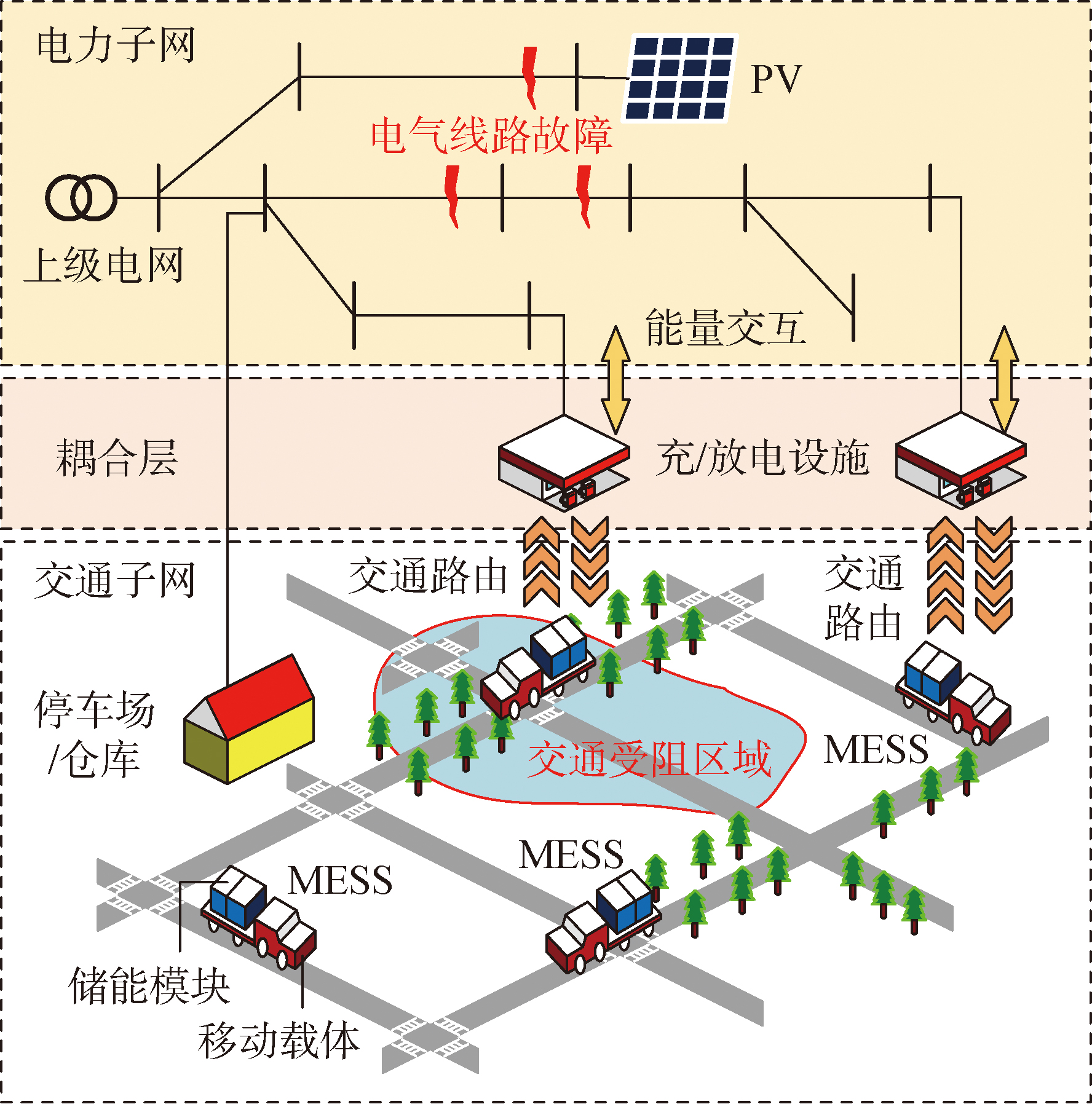
[Objective] Mobile energy storage systems (MESS) offer both energy supply and spatial dispatch flexibility. This paper proposes a pre-allocation and optimal scheduling framework for MESS that explicitly considers power-transportation coupling, aiming to safeguard critical loads and optimize system operation under multi scenarios. [Methods] The power and transportation network are modeled as weighted undirected graphs coupled through charging/discharging facility nodes. A comprehensive modularity index is introduced for regional partitioning, ensuring strong electrical connectivity and high traffic accessibility within each partition. A bi-level optimization model is constructed to determine warehouse pre-allocation of MESS and optimize multi-scenario routing and charging/discharging scheduling strategies. The shortest-path preprocessing method is employed to accelerate solution performance. [Results] Case studies on a modified IEEE 33-bus distribution system and the Sioux Falls 24-node transportation network verify the proposed method. The results show that the proposed framework achieves reasonable spatial allocation and flexible dispatch of MESS. Compared with partitions based on single electrical or traffic indicators, the comprehensive modularity-based partitioning better reflects power-transportation coupling characteristics. The bi-level optimization model significantly improves MESS scheduling efficiency and enhances the supply capability of critical loads under multi-disaster conditions. [Conclusions] The proposed method provides theoretical support for the planning and operation of MESS by leveraging both spatial flexibility and cross-domain coordination.
mobile energy storage system / coupling power-transportation network / bi-level optimization / spatiotemporal flexibility
| [1] |
黎博, 陈民铀, 钟海旺, 等. 高比例可再生能源新型电力系统长期规划综述[J]. 中国电机工程学报, 2023, 43(2): 555-580.
|
| [2] |
别朝红, 林超凡, 李更丰, 等. 能源转型下弹性电力系统的发展与展望[J]. 中国电机工程学报, 2020, 40(9): 2735-2744.
|
| [3] |
王月汉, 刘文霞, 姚齐, 等. 面向配电网韧性提升的移动储能预布局与动态调度策略[J]. 电力系统自动化, 2022, 46(15): 37-45.
|
| [4] |
|
| [5] |
张璐, 黄睿, 王照琪, 等. 考虑恢复力与经济性均衡的配电网移动储能优化配置策略[J]. 电力系统自动化, 2020, 44(21): 23-31.
|
| [6] |
丁明, 刘先放, 毕锐, 等. 采用综合性能指标的高渗透率分布式电源集群划分方法[J]. 电力系统自动化, 2018, 42(15): 47-52, 141.
|
| [7] |
李金雨, 宋福龙, 马俊杰, 等. 基于5G基站可调度潜力与配电网集群划分的储能选址定容方法[J]. 电力系统自动化, 2023, 47(18): 151-160.
|
| [8] |
丁明, 方慧, 毕锐, 等. 基于集群划分的配电网分布式光伏与储能选址定容规划[J]. 中国电机工程学报, 2019, 39(8): 2187-2201.
|
| [9] |
魏震波. 复杂网络社区结构及其在电网分析中的应用研究综述[J]. 中国电机工程学报, 2015, 35(7): 1567-1577.
|
| [10] |
王钰山, 邓晖, 王旭, 等. 考虑台风时空演变的配电网移动储能优化配置与运行策略[J]. 电力系统自动化, 2022, 46(9): 42-51.
|
| [11] |
黄煜, 徐青山, 许彪, 等. 采用图割算法的含风电电网动态分区备用配置[J]. 中国电机工程学报, 2020, 40(12): 3765-3774.
|
| [12] |
|
| [13] |
|
| [14] |
|
| [15] |
|
| [16] |
|
| [17] |
|
| [18] |
|
| [19] |
|
| [20] |
|
| [21] |
|
| [22] |
|
| [23] |
|
| [24] |
|
| [25] |
|
| [26] |
|
| [27] |
|
| [28] |
管章雷, 赵天阳, 蔡泽林. 移动储能网络与配电系统应急联动研究综述[J]. 湖南电力, 2022, 42(6):19-26,31.
频发的极端天气事件严重影响高度电气化的终端能源系统,亟需提高配电系统弹性。为呈现移动储能网络与配电系统的应急联动现状,首先以极端天气事件诱发的非常规突发事件为切入点,总结了目前主流的极端天气事件及其组合对电力交通耦合系统影响机理;其次分析了以仓储管理和物流分配为表征的移动储能网络模型,以呈现不同可达性条件下移动储能网络的应急能力;随后基于经典配电系统弹性优化模型,形成含移动储能网络的配电系统弹性优化策略;进而分析移动储能网络及配电系统多主体属性下的协同利益分配机制及方法;最后对移动储能网络与配电系统的应急联动研究进行展望。
The increasing occurrence of extreme weather events (EWEs) are threatening the end energy consumption under high levels of electrification,and it is urgent to increase the resilience of distribution systems. To depict the status quo of joint emergence response capabilities of the mobile energy storage networks (MESNs) and distribution systems, the unconventional emergencies introduced by EWEs are treated as the start point. The prevalent modelling techniques of EWEs and their impacts on coupled electricity and power systems (CEPSs) are summarized. The emergency response capacity of MESNs is concluded from the inventory management and logistics management perspectives considering the varying reachability conditions. Based on the classical resilient management models of distribution systems, the MESNs are incorporated into the resilience enhancement schemes. The benefits allocation among MESNs and distribution systems are overviewed from game theoretical problem formulation and equilibrium computation perspectives. The further research problems on joint emergency management of MESNs and distribution systems are highlighted.
|
| [29] |
|
利益冲突声明(Conflict of Interests): 所有作者声明不存在利益冲突。
/
| 〈 |
|
〉 |